Exploring the Untapped Potential of Fish Skin for Fashion: Interview with Isabelle Taylor
Isabelle Taylor is a beautifully unconventional surrealist fashion designer specialising in fish leather, a sustainable material made from the byproducts of smoked salmon, which she uses to create garments through her brand, Skinned Potential.
Originally from Cambridge, U.K., Isabelle Taylor discovered fish fashion during her foundation year at Central Saint Martins, where she first saw a fish-leather garment walk down the runway. Fascinated but confused, she delved deeper into the material while studying for her BA in Design at the University of Edinburgh. There, she sourced salmon skin scraps from a local fishmonger and taught herself the intricate process of tanning, dyeing, and molding the waste into wearable, eco-friendly leather.
After refining her craft at Christopher Kane, The Savile Row Academy, and working within the fish leather industry at Inversa Leather as a branding and design associate, Isabelle is now pursuing an MA at the Royal College of Art in London. Her research focuses on further innovating the fish leather industry, developing a plant-based tanning method, and exploring new techniques for integrating this unique material into fashion through sculpting, embellishment, and other forms of manipulation.
In this conversation, Isabelle shares with us her expertise on fish leather, its under-explored potential, and how her brand, Skinned Potential, is pushing the boundaries of sustainable fashion. She also reflects on the media’s reaction to her work with “fish waste” and her vision for the future of her brand and the material’s role in the industry.
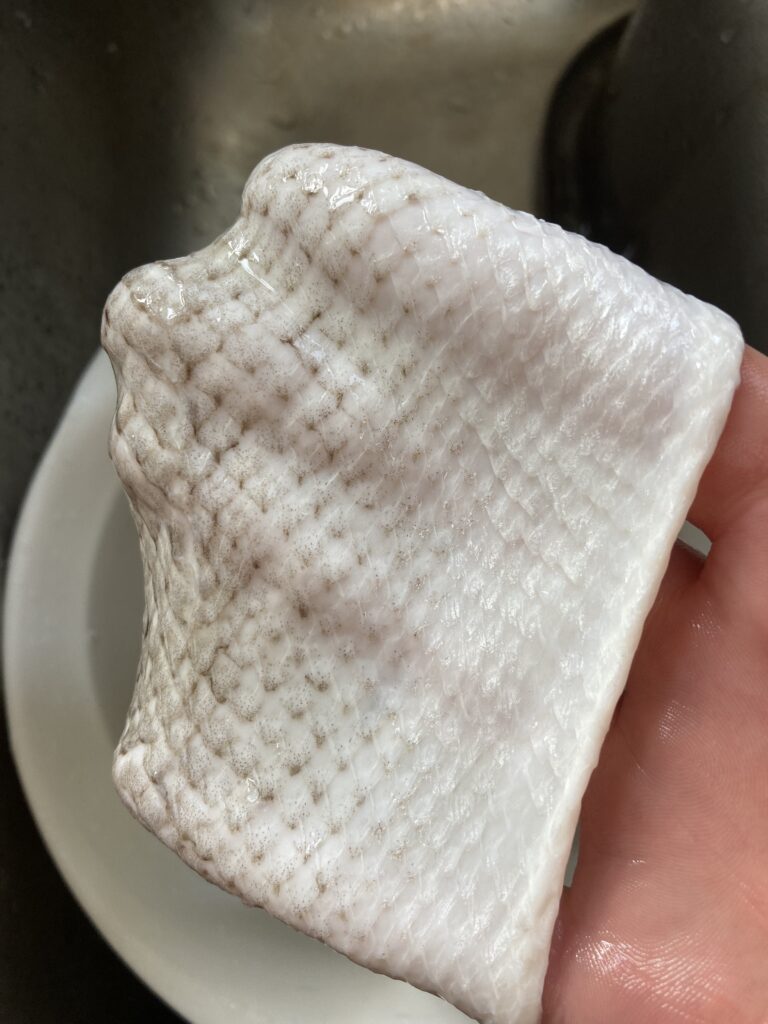
Raw fish skin
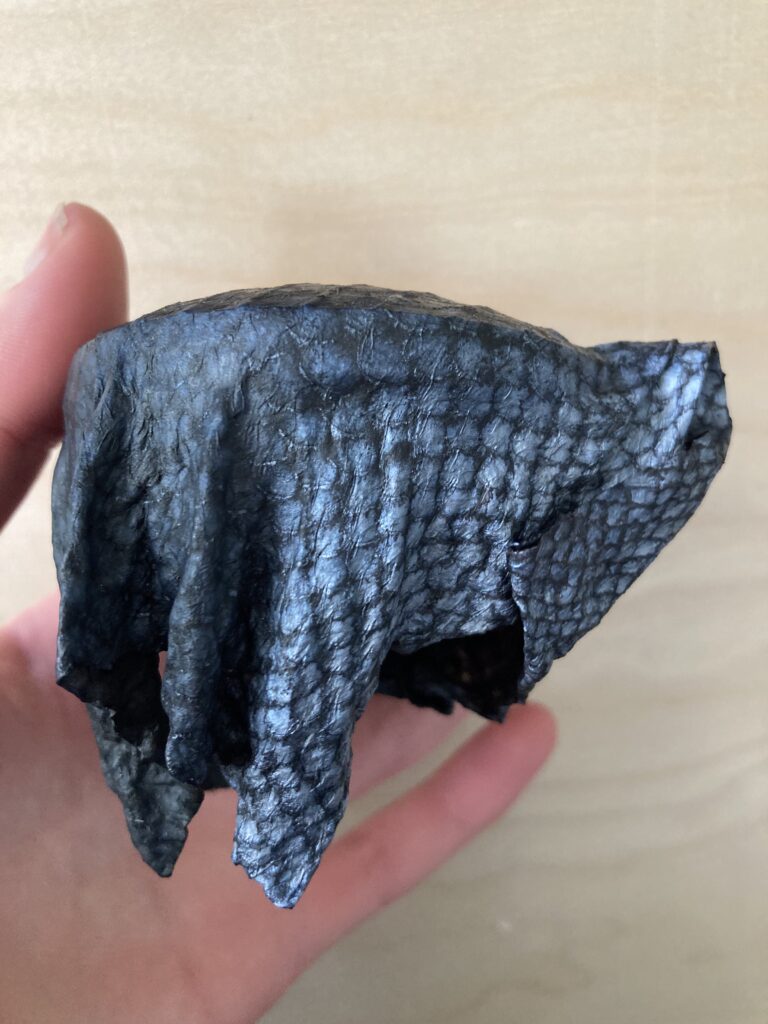
Tanned fish skin
L’ABBEYE: Could you please start by introducing yourself and explaining what you do?
Skinned Potential: I’m Isabel, a surrealist fish leather fashion designer. My mission is to showcase the many ways fish skins can be incorporated into fashion, supporting its shift towards greater sustainability. I believe that having a wide variety of textiles is crucial for creating a more sustainable fashion industry, and that’s why I’m currently pursuing a master’s at the Royal College of Art to further my research.


Sculpted fish leather dress
L’ABBEYE: A lot of people (including myself) have never heard of fish leather. How did you learn about it?
Skinned Potential: I first saw fish leather on a catwalk when I was a St. Martins student. I think it was from a designer called Joe Boone. Instantly, I was like, what is this? Why is this the first time I’m seeing fish leather? I was just so amazed and confused at the same time because in fashion, you see the same things being reimagined all the time and you see repeats. So, I had to look into it straight away. I was like, I need to know more about this right now.
L’ABBEYE: How did you even get access to fish skins in the first place?
Skinned Potential: The first time I went into a fishmonger to ask for fish skins was my second year of uni at Edinburgh when we were doing a sustainability project. I was living very close to a fishmonger and I used to walk past every day. One day, I popped in and asked, “Do you have any skins going to waste?”
After explaining that I was a fashion student they didn’t find it that weird. They were very supportive of the whole project and kept saving skins for me. In return, I wrote an article for the student newspaper about their fishmonger, to encourage students to use the fishmonger as opposed to getting fish from the supermarket.
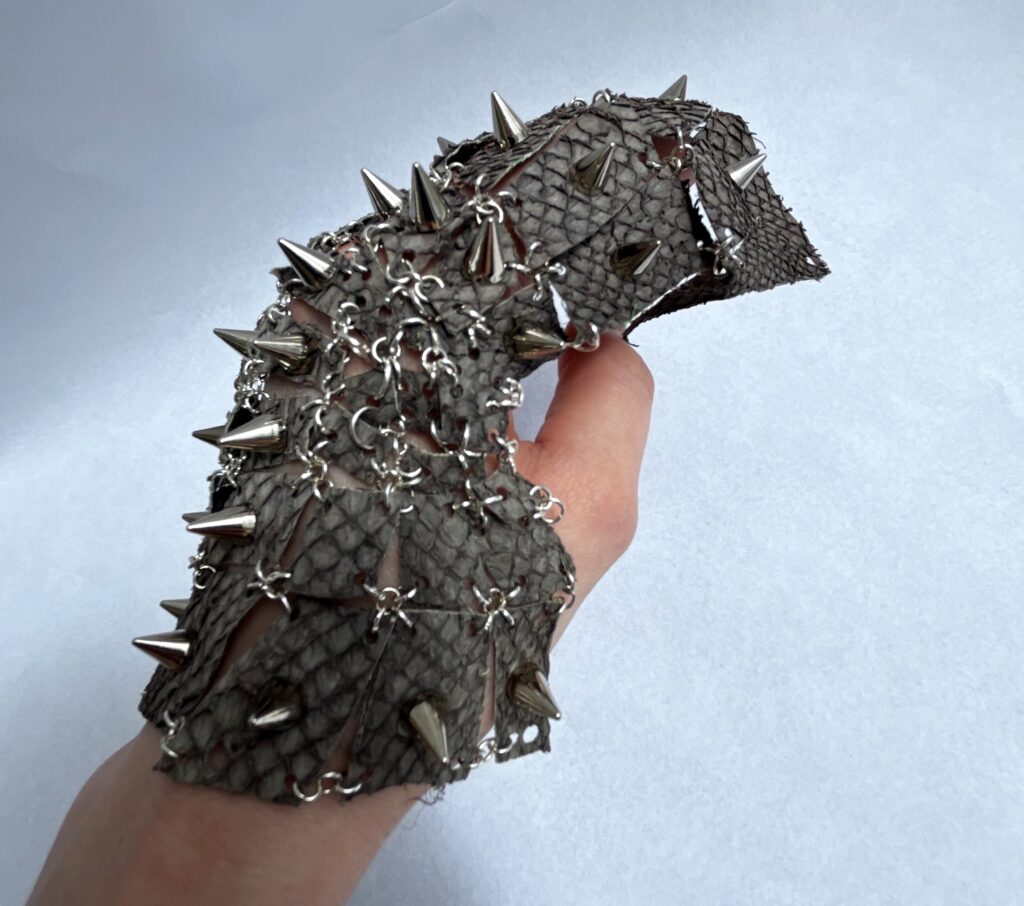
Fish Leather sample
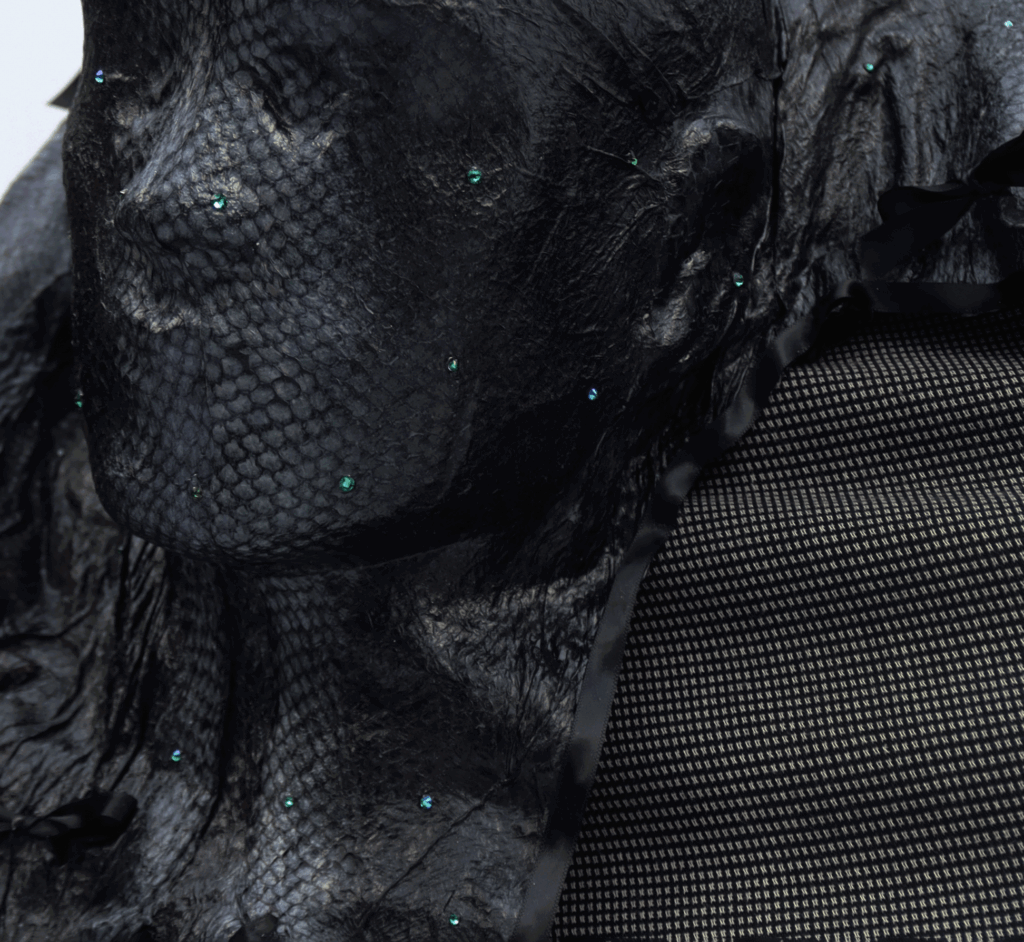
Close up Fish Head
L’ABBEYE: How do you turn fish skins into leather?
Skinned Potential: I taught myself by reading a lot online and watching YouTube videos as well as reading academic papers and books at my university. It starts by taking the skins out of the freezer, removing the scales and any excess flesh. Then I deep clean them using an enzyme wash, which is essentially just laundry detergent. Then you tan them. Fish leather is essentially fish skin that has been tanned. The collagen binds with the tannins and that changes the structure of the skin to make it last for as long as you like. Depending on how you tan the leather, you can dictate how long the leather lasts. I can make informed decisions about what I want to achieve textile-wise. Then it’s just a matter of drying it out and you’re ready to go.
L’ABBEYE: Can fish leather only be made from salmon skins?
Skinned Potential: No! It doesn’t have to be salmon. Smoked salmon is best as they have taken the skins off before smoking the meat. I actually used smoked skins because when they smoke the salmon, it doesn’t go above a certain temperature. So, the skin’s protein hasn’t denatured yet. It’s still very much intact. Also, salmon are good because they are relatively big and strong, so it is good for leather. But I have tried quite a few other different types of fish with the fishmongers that I’m working with at the moment. I like taking advantage of the different design possibilities the different skins inspire. For instance, some of the skins they gave were pure white. So I immediately thought a monochrome look would be great.
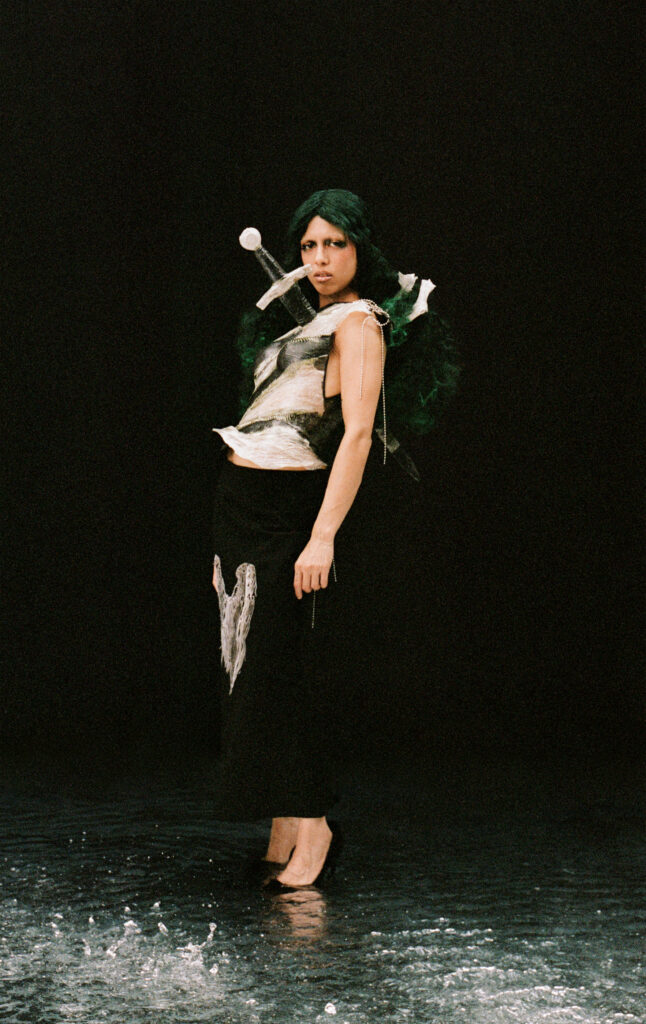
Skinned Potential, “Love”, sculpted fish leather top and fish leather bird sewn on repurposed skirt
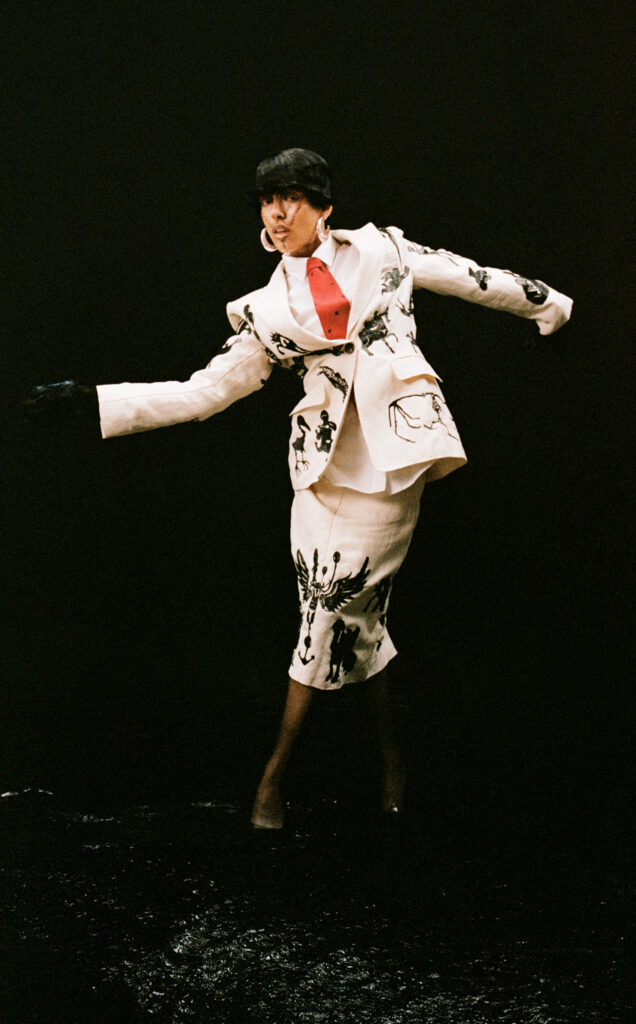
Skinned Potential, “Imagination”, fish leather on repurposed suit
L’ABBEYE: What’s the most interesting thing you have discovered?
Skinned Potential: When I get the skins, they just come in a bag. I find it really exciting to have that variety because you never know what you’re going to get and it’s quite a creative challenge to work with what you’ve got and use it to your advantage. Also, realizing where the gaps are in the research and thinking of new solutions or materials from the gaps. I like the experimental aspect of fish leather in that way.
I recently found out that it’s not just leather that you can make from fish skin, there’s also fish parchment, which is slightly different as the fibres haven’t oxidized and you end up with more of a translucent product as opposed to a thicker, durable leather. From fish skin, you can achieve quite a vast range of outcomes. For instance, if it’s too acidic the protein denatures and melts, you can watch the fish skins melt into each other which I also think is so cool and isn’t being researched. You can create a whole new material that isn’t leather. Finally, through tanning you’re in control. I think that is really interesting because in fashion, you’re always thinking about how long is my garment going to last on the planet? So having that control as a fashion designer is really exciting for me. That is the part of my practice I find most interesting.
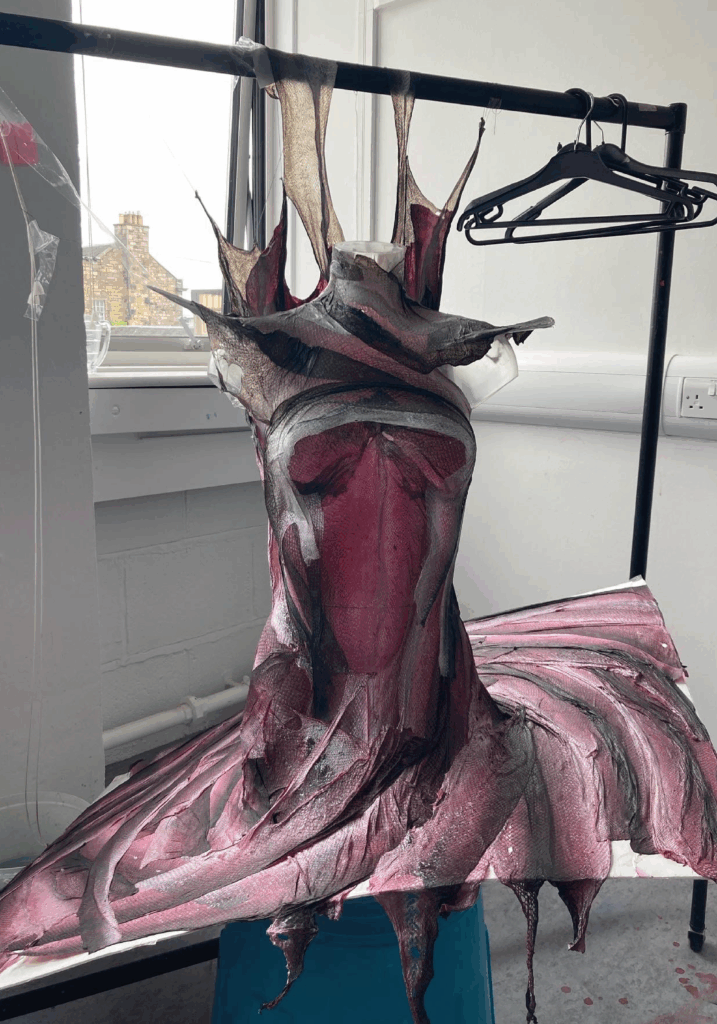
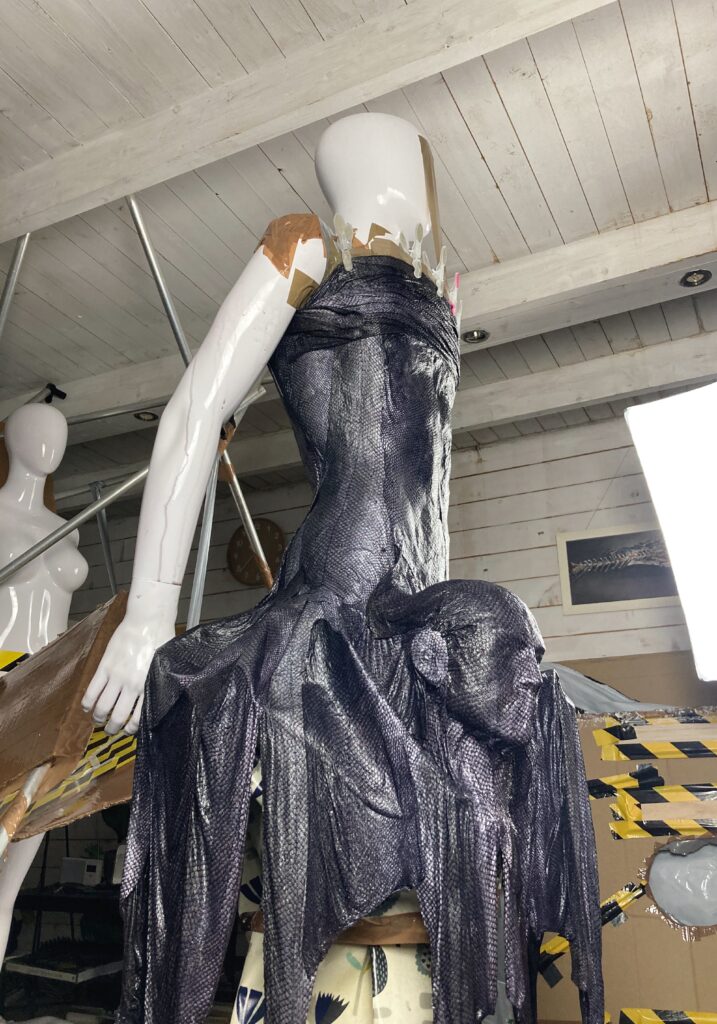
Fish leather drapings
L’ABBEYE: Fish leather is not a new material innovation, right?
Skinned Potential: No! Quite a few indigenous cultures use fish leather as their clothing. The Heza people and the Nivk people make all their clothing from fish skin because they’re coastal communities. Also, fish leather has been used since ancient Egypt. They used to make jewelry and clothing, and even armour. So throughout human history, fish leather has been used practically the whole time. It’s just sort of been neglected in modern fashion, which is super fascinating to me.
L’ABBEYE: Why do you think that is?
Skinned Potential: I have no clue. It’s always baffled me. It looks a little bit like snakeskin. So, you can see it as an exotic skin and then people just prefer to use a snake because it’s bigger and maybe seen as more luxurious in people’s heads and more romantic. Also, I think people think of fish skin as something that is on your plate, not on your body.
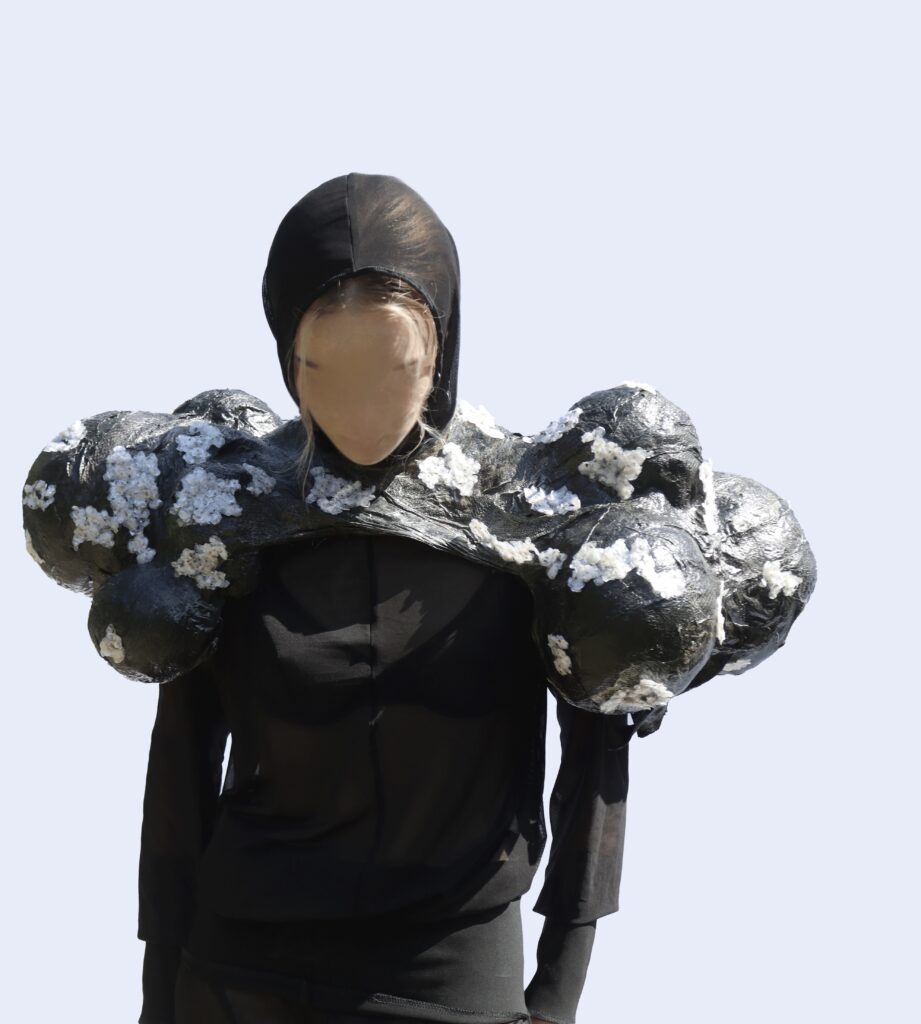
Skinned Potential, “Head in the clouds”
L’ABBEYE: Do you get any negative reactions to your work?
Skinned Potential: I definitely get negative comments. However, on different platforms people react in different ways. My first press was Lad Bible. I was so excited; I was like, this is going to be my big break. But it was the opposite of a big break because everyone was hating on it. They made so many jokes like “this girl is gross, this is so gross.” But I didn’t care in the absolute slightest. It’s just a lack of understanding of what I’m doing and I think if you don’t have all the information about my practice, you can be concerned. And I think I encourage people to be concerned because it’s important to question people’s practices.
L’ABBEYE: Do you eat fish, Isabelle?
Skinned Potential: I’m basically a vegetarian. So I’m one of those people who eats an extremely small amount of meat and fish. I do feel very guilty eating fish and meat which is why I don’t eat it.
L’ABBEYE: What do you hope for the future of fashion with fish leather?
Skinned Potential: I am passionate about using fish leather to promote diversity of fabrics available to designers as that is the way forward and the only way to make things sustainable. Anything done at mass production is unsustainable because it’s using too much land, too many resources, etc. So when it’s more diverse and more options are available, you can make the production smaller and you can make it local. If we’re all working local and smaller, we’re going to be more sustainable as a world. So that’s where I see the future of fish fashion, making things more local.
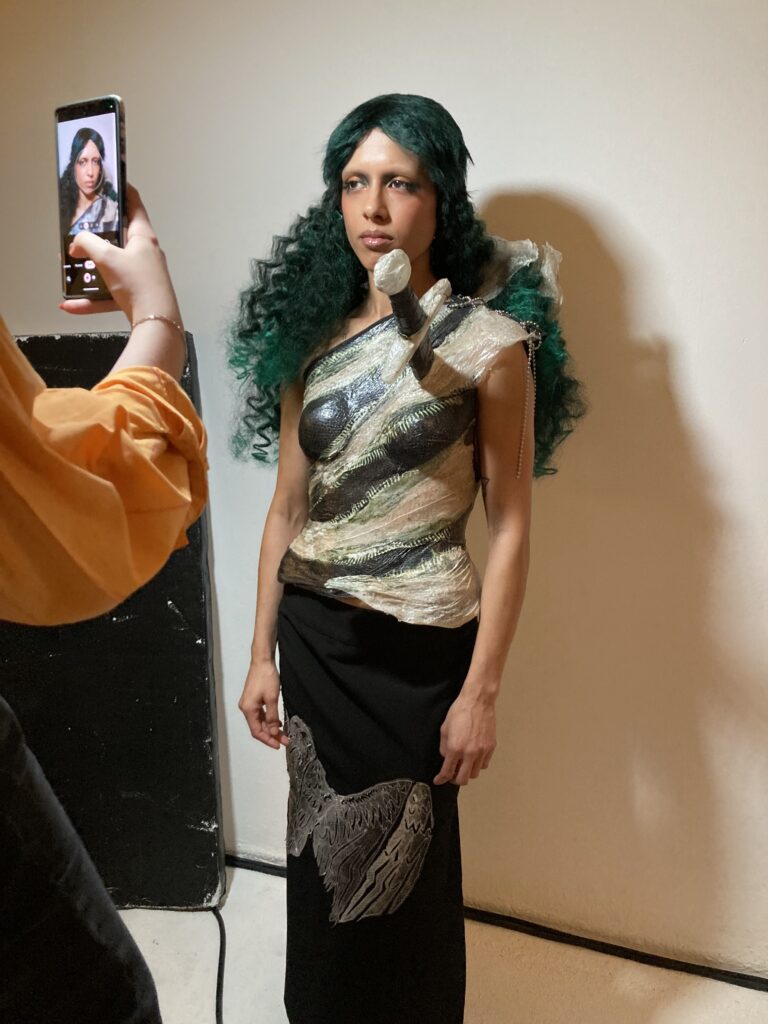
Skinned Potential, “Love” BTS