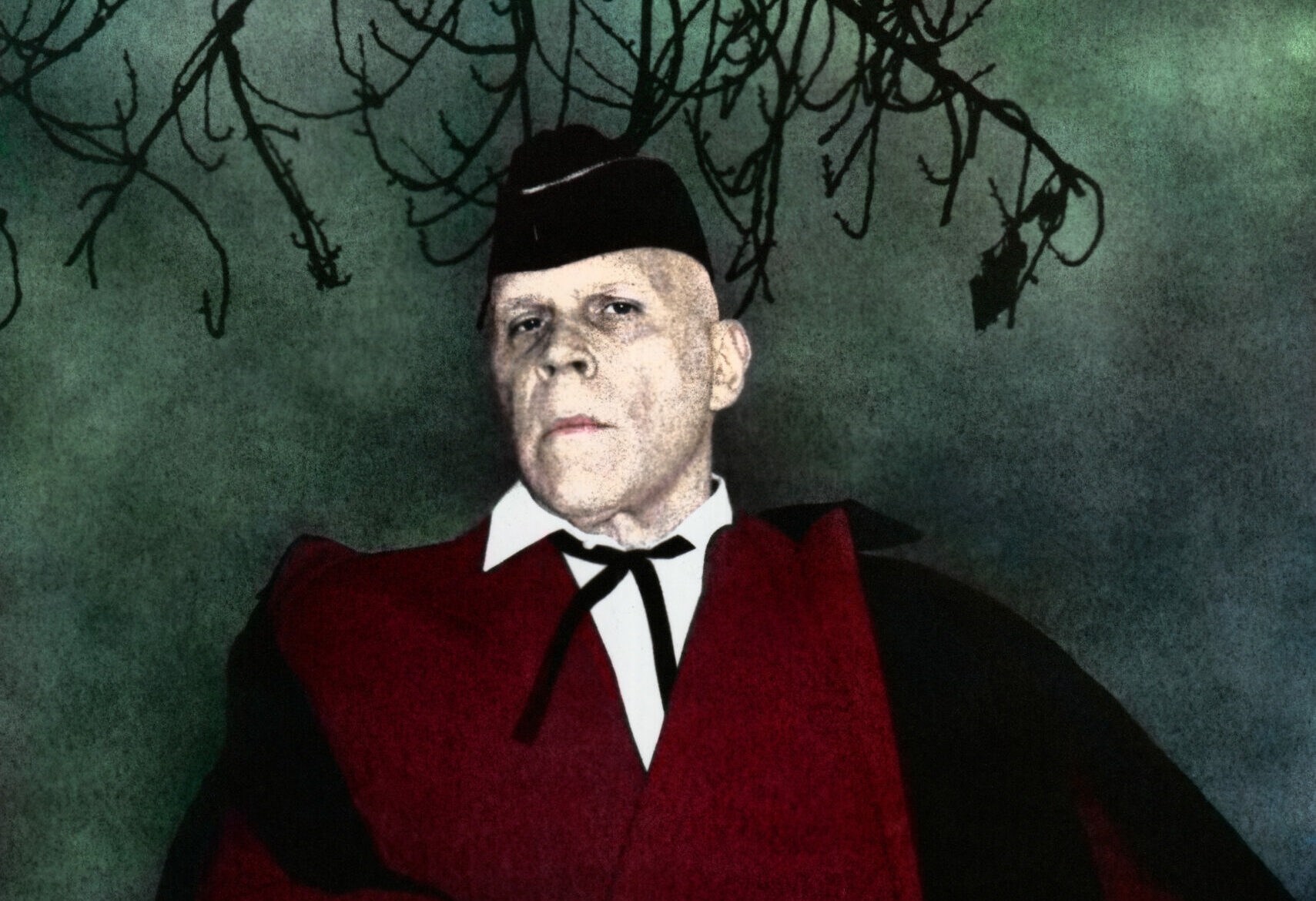
NIKOLAS SCHRECK – THE RENAISSANCE MONSTER
Artist, writer, filmmaker and former Radio Werewolf frontman, Nikolas Schreck has spent decades exploring the intersections of music, ritual, cinema and mythology. In this in-depth conversation, he reflects on the legacy of Radio Werewolf, his collaboration with Christopher Lee, the controversy of Charles Manson Superstar, and his vision of art as spiritual transmission in an age of digital distraction.
Nikolas Schreck is an eclectic and provocative artist whose career spans music, film, writing, and ritual practices, consistently challenging conventional boundaries of contemporary art. He first gained recognition with Radio Werewolf, a project in the 1980s and ’90s that fused music, theater, and ritual into a singular total work of art, inspired by Richard Wagner’s concept of the Gesamtkunstwerk and Antonin Artaud’s Theater of Cruelty. Every element of the project from performances and recordings to posters and concert programs was designed as part of a unified whole, intended to extend beyond the stage and into the lives of the audience, confronting perceptions and transforming the experience of art into a form of ritual. Following Radio Werewolf, Schreck embarked on a solo career that reflects his multidisciplinary vision: his music is less entertainment than transmission, invocation, and inner architecture; his writing and filmmaking explore myths, marginalized figures, and socially demonized subjects, always aiming to clarify, deconstruct, and reveal hidden truths. His work has led to extraordinary collaborations, such as with Sir Christopher Lee, and to groundbreaking documentaries like Charles Manson Superstar, projects conceived not to sensationalize but to illuminate the complexity of misunderstood figures.
Today, Schreck continues to navigate music, literature, and film with the same visionary intensity that has defined his career. His art remains an invitation to contemplation and reflection, challenging cultural conformity and offering a profound depth of aesthetic and spiritual experience.
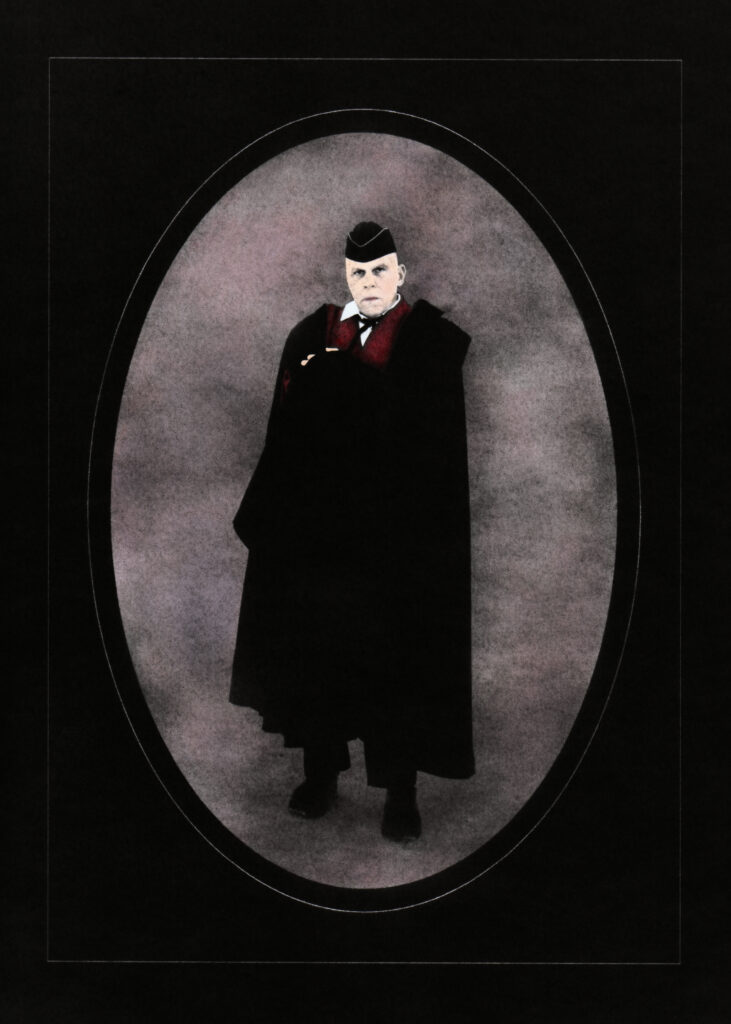
Before your solo career began in 2014, your work with Radio Werewolf combined music, ritual, and theatrical performance in a very radical way. What originally drew you to that kind of multidisciplinary expression?
Radio Werewolf was inspired by another RW, Richard Wagner, my favourite composer and the creator of the concept of the Gesamtkunstwerk or total work of art. Harkening back to the sacred ritual theatre of ancient Greece, Wagner sought to unify all the arts into a larger than life epic experience that would not just entertain but transform. Radio Werewolf was more than just the recordings and the concerts, every aspect of it, the posters designed to advertise our concerts, our television appearances, our stage presentation, the programs we provided the audience as one is given at classical concerts were all part of a greater unified whole. The theories and practice of Antonin Artaud’s Theater of Cruelty also inspired and influenced me in that RW like Artaud did not seek to present a soothing diversion but an awakening confrontation with the audience. It was
important to me that the spectacle didn’t stay safely contained to the stage but crossed over into the minds and lives of our audience. Paradoxically despite the theatrical nature of Radio Werewolf I think what disturbed and intimidated some weak souls was that it entered “real life” in a way most musicians never do. We were recording in a studio where Alice Cooper was also recording and he said to us, “I’m doing an act, you guys are real.” It was a ritual so it exists outside of time, attracting new listeners all the time.
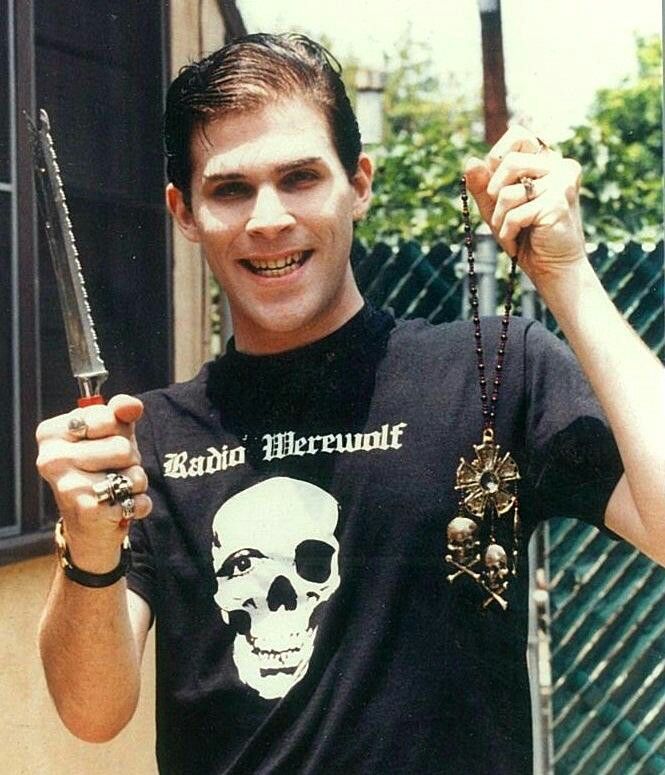
Nikolas Schreck of Radio Werewolf around 86
I know you’re writing a new book about your friendship with Sir Christopher Lee, can you tell me more?
I knew Christopher as a friend and a musical artistic collaborator from 1995 until his death 20 years later. I produced his first singing album and worked with him on two other projects . The more he’s passed into iconic legendary status the more I felt that this complicated, sensitive and sometimes difficult being deserved a more comprehensive and honest appraisal than so far exists. He was just as fascinating as any of the larger than life figures he played. The book is partly a memoir of our friendship, providing an intimate portrait of the man concealed beneath the aloof persona, but also analyses in depth his fraught love/hate relationship with the infamous character he became so identified with: Count Dracula. As with all my work, I’ll debunk several popular myths commonly believed.
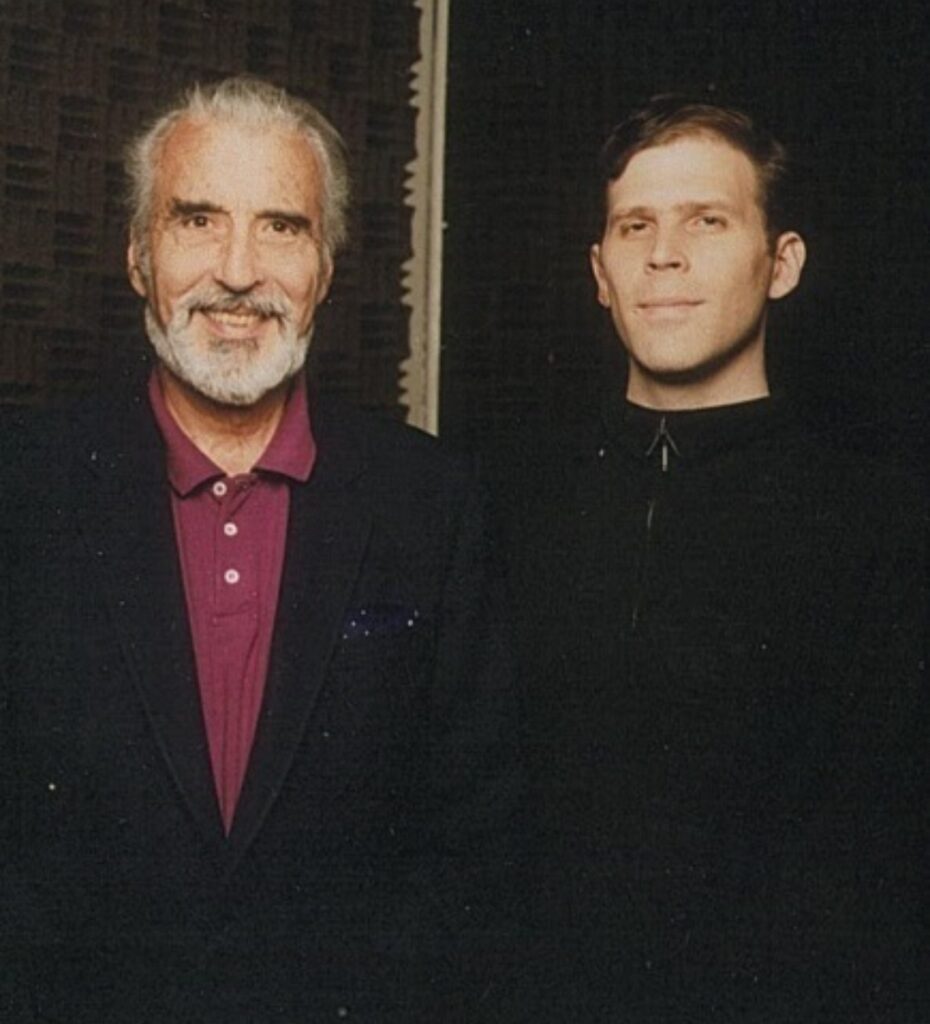
Christopher Lee and Nikolas Schreck
Looking back at Radio Werewolf’s European phase, which has been described as anticipating the dark-ambient and ritual industrial movements of the ’90s, how do you view that legacy today?
I don’t do much looking back. We sensed the coming collapse of what remained of civilization in those works, as best exemplified by the 1990 RW album Songs For The End of the World. I know that phase of the ritual inspired other musicians but honestly I never felt a part of any genre or scene, the work of RW was not really connected to any subculture, so I haven’t given much thought to the legacy. Some of the musicians we’ve inspired took the most superficial and sensational aspects of the work and dumbed it down. I’m more concerned with what I’m doing right now.
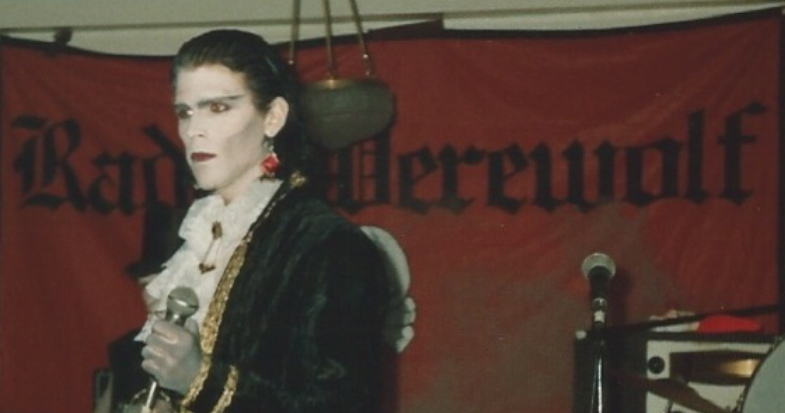
Nikolas Schreck live with Radio Werewolf -1986
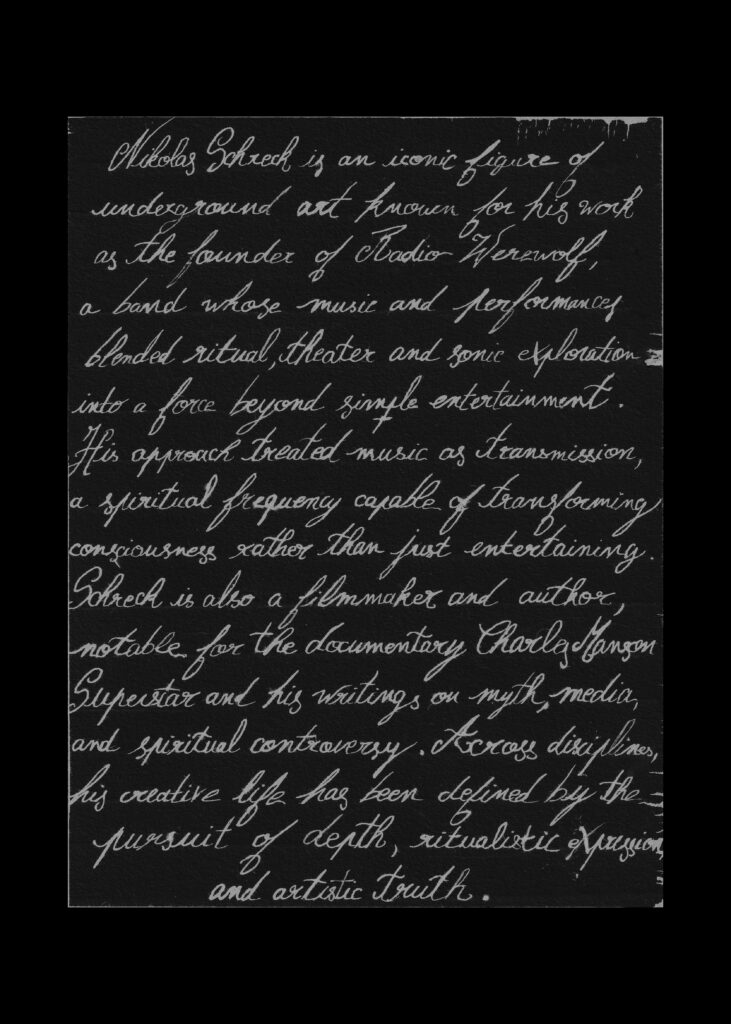
You’ve moved fluidly between music, writing, film, and spoken work. Do you see these as separate disciplines, or as different expressions of the same underlying vision?
I percieve all of it as one overarching deeply interconnected megawork manifested in different forms.
What does Satanism mean to you today? Why are people so afraid of it?
I’ve been a fierce critic of Satanism for decades. What it means to me today is a lot of lost souls, most of them traumatized by negative experiences with mainstream Christianity, find a conformist identity in the pop culture cliches associated with Satanism. But as I’ve pointed out in many lectures and writings, the real Satan, which is an existing being, not a symbol, is actually the loyal servant of Yahweh, so the whole thing is rather pointless and spiritually incoherent, all too often more of an aesthetic fashion and music lifestyle than any kind of genuine metaphysical practice.
Your music often feels less like entertainment and more like an invocation or a transmission. What do you hope the listener experiences on a psychological or emotional level?
When I create a song I don’t think about what a prospective audience might think about it or how they might react. It is a transmission that comes to me from some other world and I transmit it to those receptive. What they make of it is entirely up to them. I don’t think art should be explained. It should be experienced. I see music as an art not a trivial entertainment, in the sense that entertaining implies distraction.
Do you still think of performance as a kind of ritual or has that concept transformed for you over time?
Performance is always a ritual.
Charles Manson Superstar remains one of the most controversial documentaries ever made. What motivated you to explore Manson as a cultural figure rather than a mythologized monster?
Because the more I got to know the real person rather than the media created myth I saw that he was completely misunderstood. I felt a moral responsibility to give him an opportunity to speak without being censored or treated like a freak show to titillate the ignorant public. His philosophy and music deserve to be known on their own merits, not as part of the usual true crime narrative limitations usually sold to the public.
You’ve written extensively about cinema, mythology, and marginal figures. What draws you to subjects that society tends to simplify or demonize?
It drives me crazy to see how wrong the popular imagination is on so many of the subjects I’ve explored. I have a pedantic compulsion to clarify and find the truth hidden behind the generally accepted official narrative.
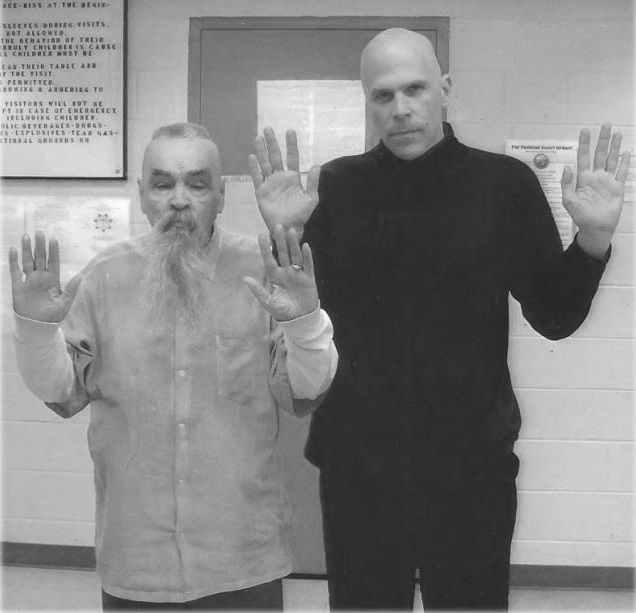
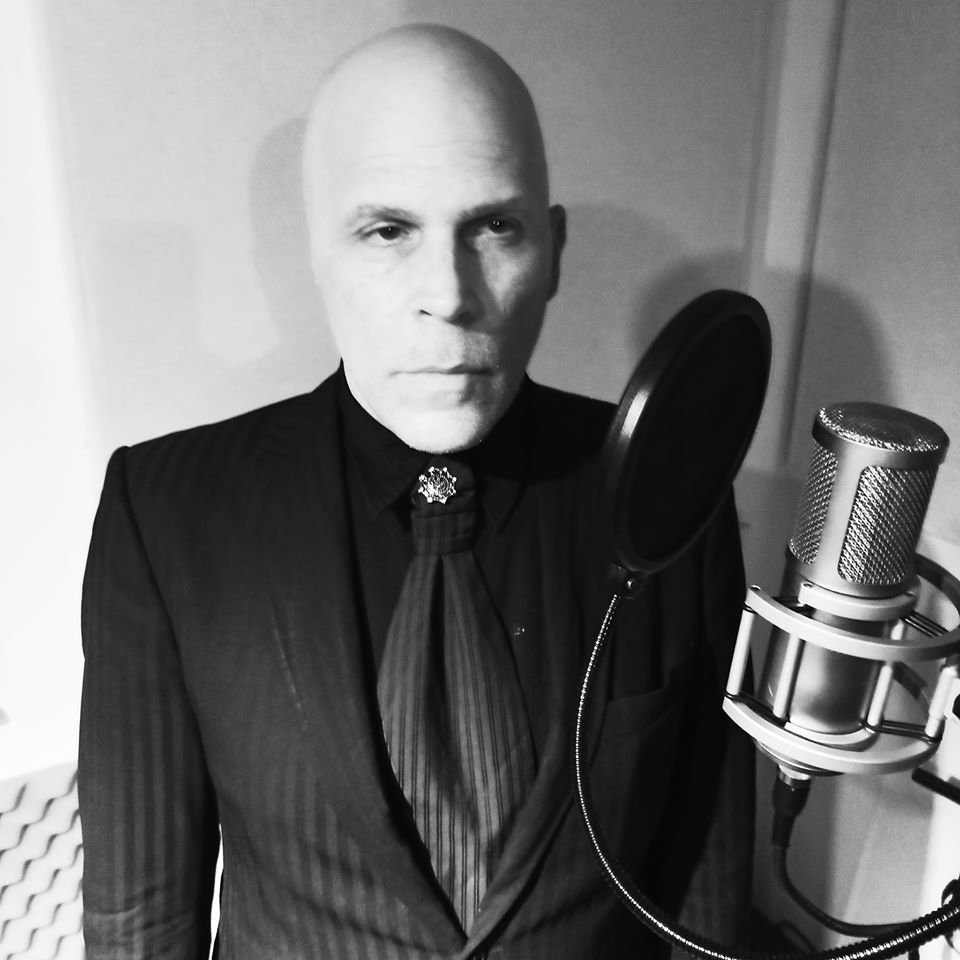
Your work suggests a lifelong process of questioning belief systems and collective myths. What kinds of questions feel most urgent to you today?
Without a doubt the most urgent question today is how does a spiritually aware person navigate the ever worsening dark age of dystopia that’s intensified so dramatically in the last six years or so? It’s a matter of life or death.
What are you currently working on, and what excites you most about the direction you’re heading now?
I’m working on several books and recordings but most of my energy since 2024 has gone to completing an epic documentary on the truth about the Tate-LaBianca murders. I’m excited about returning to recording new music and performing which is what I’ll concentrate on again this year.
In an era of short attention spans and algorithm-driven culture, how do you feel about depth, contemplation, and intellectual risk in art?
I deplore the effect short attention spans and algorithms have had on the human mind and consequently on culture in general. It’s made everything shallow, simplistic and stupid. Very few take the time to contemplate anything in this addictive cycle of digital distraction. I oppose this trend by recording long songs, writing exhaustive long books and approaching the subjects I lecture about from a detailed complex perspective.
With Radio Werewolf you described sound as a kind of transmission or “dominant frequency.” How do you think sound interacts with consciousness?
I’ve given several public teachings on music and metaphysics, often on a day after my concerts, which can be found on my YouTube channel. Sound is the most spiritual and ethereal of all the senses and as almost every religion and spiritual tradition demonstrates, music is one of the most profound methods of transforming consciousness, since it transcends the rational mind and acts as a medium for the transcendental. I find it both amusing and horrifying how idiot conspiracy theorists complete fail to understand what I said about music and consciousness in Radio Werewolf interviews decades ago. I don’t think humans now can grasp it.
Your work with Kingdom of Heaven and your solo albums involves different collaborators. What do you look for in a creative partner?
An intrinsic sense of musicality, a willingness to improvise and be spontaneous, a sense of humour, strong discipline and work ethic, and an ability to play a wide range of musical styles, not just one genre.
Songs like “Lord Sutekh’s Dream” and The Futura Model have very evocative titles. Do you conceive your music visually or narratively before composing it?
There’s no fixed pattern. Sometimes a melody will come to me first, other times a few lyrics will pop into my head, there is no formula to my songwriting. I rarely sit down at my
keyboard to deliberately write a song, usually they come to me spontaneously. I’m a vehicle for them, like a radio picking up a transmission.
You’ve written books on cinema, mythology, and cultural figures. How does writing differ for you from composing music or making film?
I much prefer music and film to writing non-fiction books, as music and film are more poetic, less linear and more transcendent. When I’m finished with my next series of non fiction books I’ll concentrate on literary fiction which is more visionary .
When you made Charles Manson Superstar, what were you trying to communicate beyond the sensational headlines?
As the film itself says it was deliberately designed as a deprogramming tool. I’ve compared it to a psychedelic trip that awakens the viewer to hidden realms of consciousness that transcend the received knowledge of sensational headlines. It was very much created as an antidote to the lies of mainstream news.
Are there cinematic techniques or directors that have influenced how you think about filmmaking and storytelling?
In terms of documentaries, Hans Jürgen Syberberg is a great influence. As I eventually move into theatrical features, there are so many: Terence Fisher, Alain Resnais, Nicolas Roeg, Edgar Ulmer, James Whale, too many to name.
Having embraced Tantric Buddhism later in your life, what aspects of that practice have influenced your creative work?
I’m very careful not to use my music or other creative pursuits to preach any particular belief system but I think anyone familiar with Tantric Buddhism will see there is a subtle dharmic undercurrent to all of my solo work since 2014. It’s just not obvious.
How do you balance structured spiritual discipline with the spontaneous nature of artistic creation?
I don’t see them as separate at all, spontaneity must come from discipline or it’s just formless chaos.
Is there a particular meditation practice or teaching that you feel has been most transformative for you?
Yes, I can say without a doubt that the Vajrasattva karma purification of Tantric Buddhism and the Mahamudrea meditation taught by my particular school the Karma Kagyu have had the most profound effects on my mind and life.
You’ve lived and worked across the U.S. and Europe. How has Berlin influenced your music, writing, or worldview?
No other city on earth has drawn me to it so much, from my earliest memories I knew I lived there in at least one past life. There is no aspect of my creative work that isn’t influenced by Berlin, although my album Berlin Noir is the most obvious.
What kind of feedback from listeners or readers has stayed with you most over the years?
I’m grateful for the support and enthusiasm I’ve received for my work but unlike other musicians and writes I know, validation and feedback aren’t important to me, only the work itself. I’m gratified when my work is understood as it means I communicated but I don’t care when it’s not. I guess what’s made the most impression is when fans tell me my music, books or film have inspired them and strengthened them.
You’ve revisited earlier research, such as The Manson File, over time. What changes when you return to the same subject decades later – the subject itself, or your own ethical position toward it?
The subject, not my ethics. In the case of The Manson File, it needed to be revisited because from the time from it’s first edition in 1988 to its most recent in 2022 I kept discovering so much previously unknown information about that complex phenomenon, it absolutely screamed out to be expanded and updated. It never ends.
In recent years your musical work from Berlinoir onward feels increasingly introspective and atmospheric, almost cinematic. Has your relationship with music shifted from provocation toward inner architecture and mood?
I was never especially interested in provocation for it’s own sake. Radio Werewolf was a very specific concept that served it’s purpose at that time and was focused on a particular range of themes. My solo work is far more personal and interior , so yes I’d agree with your assessment.
Although you are widely known for Charles Manson Superstar, cinema seems to have remained a subterranean thread in your work rather than a continuous practice. How do you relate to filmmaking today as a closed chapter, or as a language that still informs how you think about sound, narrative, and myth?
I’ve been focused heavily on film-making in the past two years and will continue to explore that medium. Cinema is crucially important to me always.
Credits
PHOTOGRAPHER @MIRIAM_MARLENE
CREATIVE DIRECTION AND INTERVIEW @LILITHBABALON
ARTIST NIKOLAS SCHRECK @NIKOLAS_SCHRECK_OFFICIAL
ARTWORK @HUGOOPERIE