Jungian Archetypes and Avant Garde Fashion Persona
Carl Jung’s archetypes offer a new lens to decode avant-garde fashion. From Browne’s Trickster to Yamamoto’s Hermit, each silhouette becomes a vessel of the collective unconscious. Proof that fashion, at its most radical, speaks the language of the soul.
If avant garde fashion has shown us anything, it’s that clothing can transcend adornment. We’ve seen fashion make political statements and challenge ideologies. At its core, the avant-garde seeks transformation. A silhouette, texture or form can hold meaning, and might even reveal our most human desires. This pursuit of meaning through visual languages places avant-garde at an intersection with other symbolic systems: psychology, art, and ritual. These systems ask fundamental questions: Who are we, truly? What are we trying to tell each other? How do we become whole?
In search of answers, we turn to the worlds around us and to our personal experiences. We might unearth these questions through clothing, literature, or even by wrestling with our own diaries. And within these symbolic realms– between personal experience and collective myth – we find the work of Swiss psychoanalyst Carl Jung, who attempts to give us some answers.
According to Jung, beneath all of our conscious minds lies a kind of pre-existent ‘knowing’. He calls this the collective unconscious: a shared layer of the psyche made of all the experiences, instincts, and symbolic patterns of the human species. It’s like a blueprint passed down through generations. One that whispers shakily to us, shaping how we make sense of the world.
Within this collective unconscious there are archetypes, or innate characters of the human spirit. These include the Mother, the Trickster, the Shadow, the Persona, the Hero, among others. Each represents a fundamental human drive, value, or internal tension. For example, the Persona represents the social mask we wear to fit in. The Shadow holds the parts of ourselves we suppress. These archetypes recur across time and culture in dreams, religion, art and myth. Jung believed all powerful ideas, philosophies, and creative expressions carry traces of these archetypes because they speak to something universal. In this sense, ideas are not learned; they are remembered.
“For it is the function of consciousness… to translate into visible reality the world within us.” — Carl Jung
When fashion is experimental, it becomes a vessel for these internal figures. Designers are constantly tapping into shared symbols that we may not consciously recognize, but instinctively feel. A hunched silhouette might echo the Hermit. A distorted suit becomes a Trickster’s costume. The color black becomes a portal into the Shadow. Fashion becomes a reflection of the collective psyche.
Once you recognize these archetypes, they begin to appear everywhere: in relationships, in art, and within ourselves.
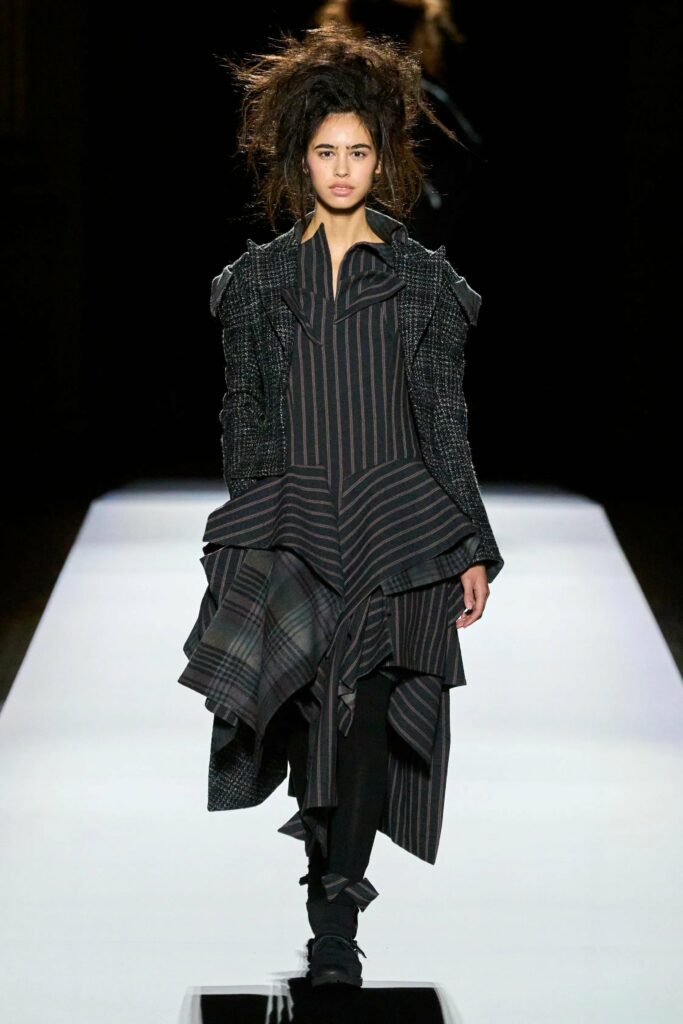
Yohji Yamamoto, FW2024
Androgynous Tricks
Take Thom Browne’s work, for example, which reimagines menswear through the lens of distortion, humor, and inversion. His theatrical styling and androgynous tailoring capture the Trickster, an archetype associated with disruption, subversion, and the absurd. In a 2016 CFDA interview, Browne described a desire to rebel against his more conservative education. His suits are serious about being playful, mirroring the Trickster’s paradoxical energy.
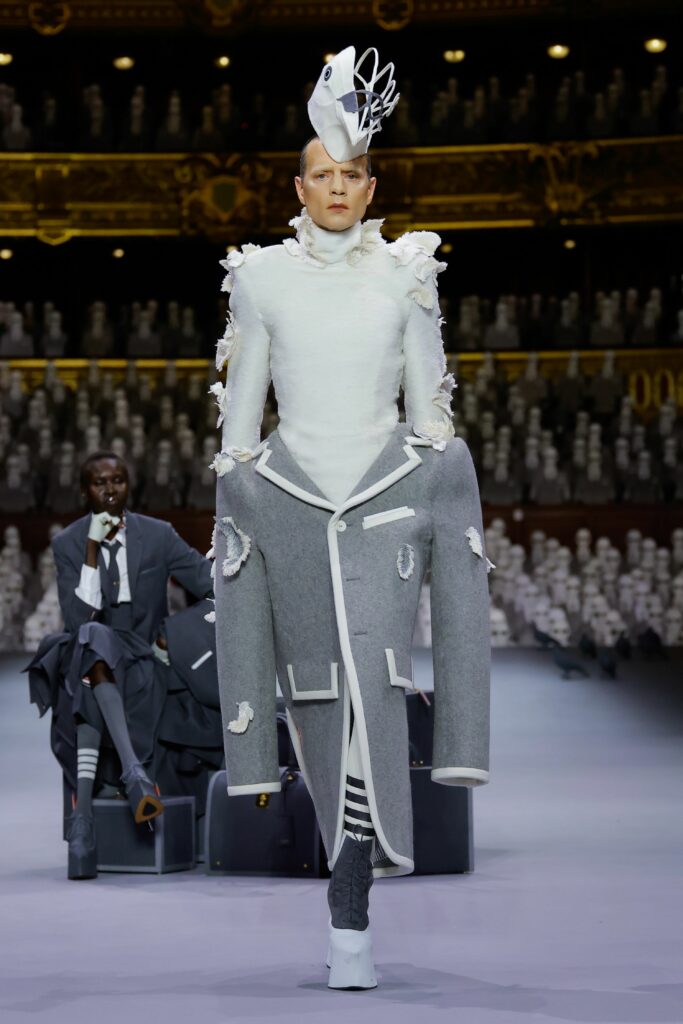
Thom Browne, Couture, 2023
Jung describes the Trickster as a myriad of inferior traits – both subhuman and superhuman, reflecting the contradictions within human nature. The bouncing, spurring things. The Trickster is also a vessel of transformation, both divine and foolish. Browne explains – “I like the idea of something that’s classic and a uniform—but it’s really important not to make it boring” (Hypebeast, 2016). His aesthetic holds Sense of Humor, and his designs uttered language that menswear had not yet known, somewhere beyond traditional suits. We’ve since learned that a suit jacket can take on many identities. Browne’s shows, through the lens of archetypes, is a performance that teaches us about wholeness and transformation through chaos.
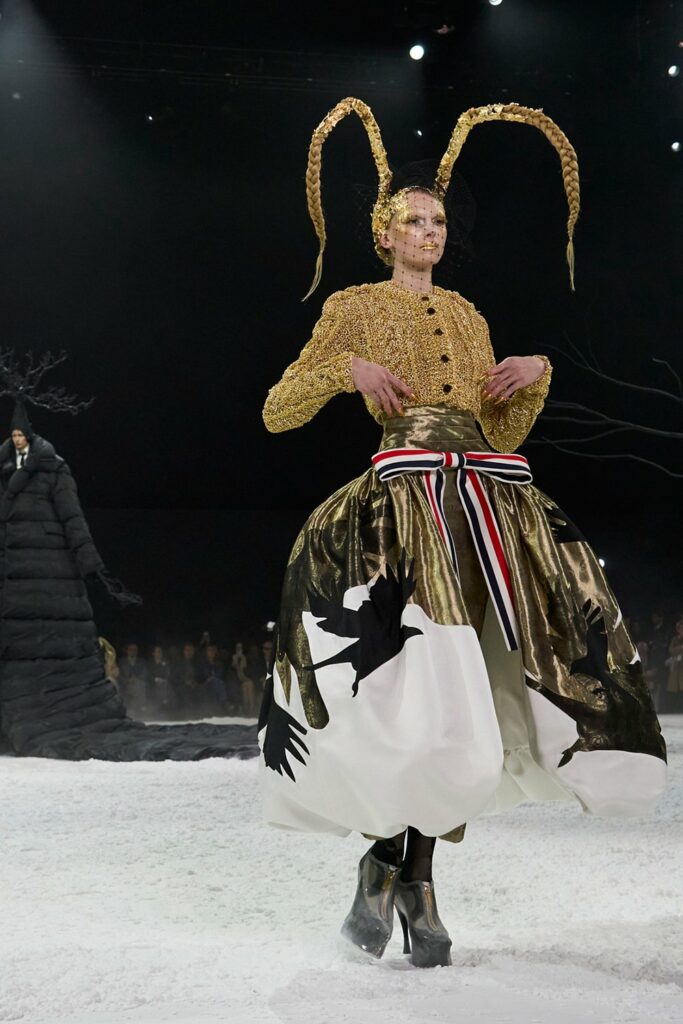
Thom Browne, FW2024
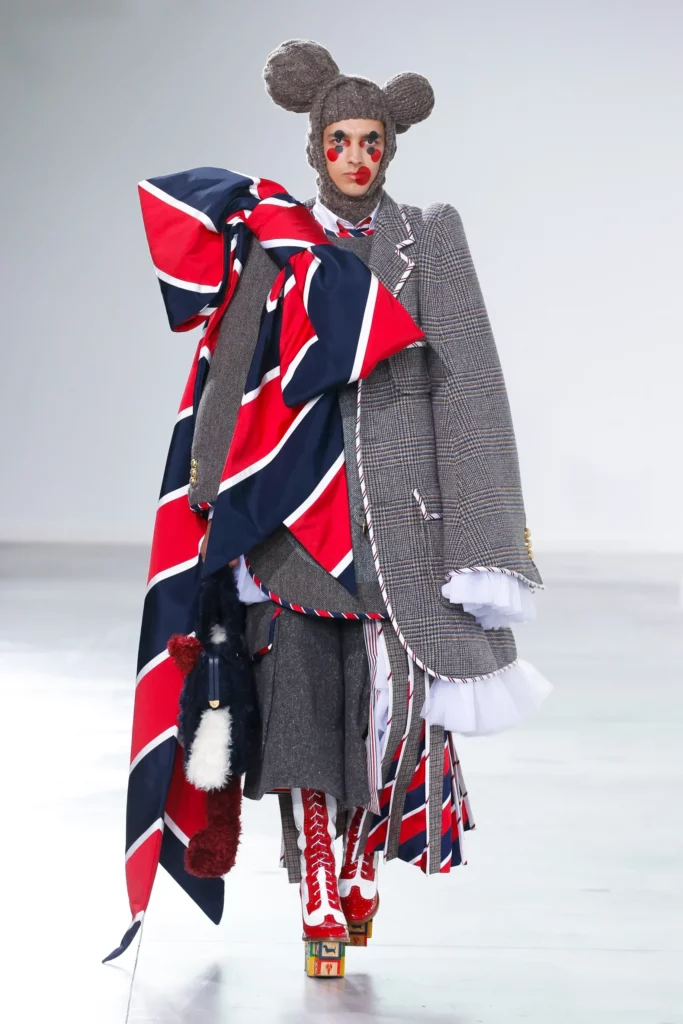
Thom Browne, FW2022
Sage, Hermit or Shadow?
If Browne dresses the Trickster, Yohji Yamamoto channels the Sage, the Hermit and perhaps even the Shadow. These are archetypes of introspection, solitude, and philosophical resistance. Yamamoto’s designs reject the commercial and the superficial, reaching instead toward asymmetry, and ambiguity. These designs sit cross-legged and hand-in-chin.
The Sage and the Hermit archetypes are both seekers of truth, but they take different paths. The Sage observes the world from a distance, while the Hermit retreats from it altogether, turning inward to confront the self. Yamamoto’s muted colors, asymmetry, and reclusive silhouettes seem to inhabit both roles. The designs are not screaming for attention but are demanding contemplation, either through inquiry or withdrawal. Black is Yamamoto’s signature – what he calls a void, “ a despair from thinking that I am nobody” (GQ, 2020). Yet for him, this void offers opportunity for depth rather than absence. He also says, “Above all, black says this: I don’t bother you—don’t bother me.” A true Hermit indeed.
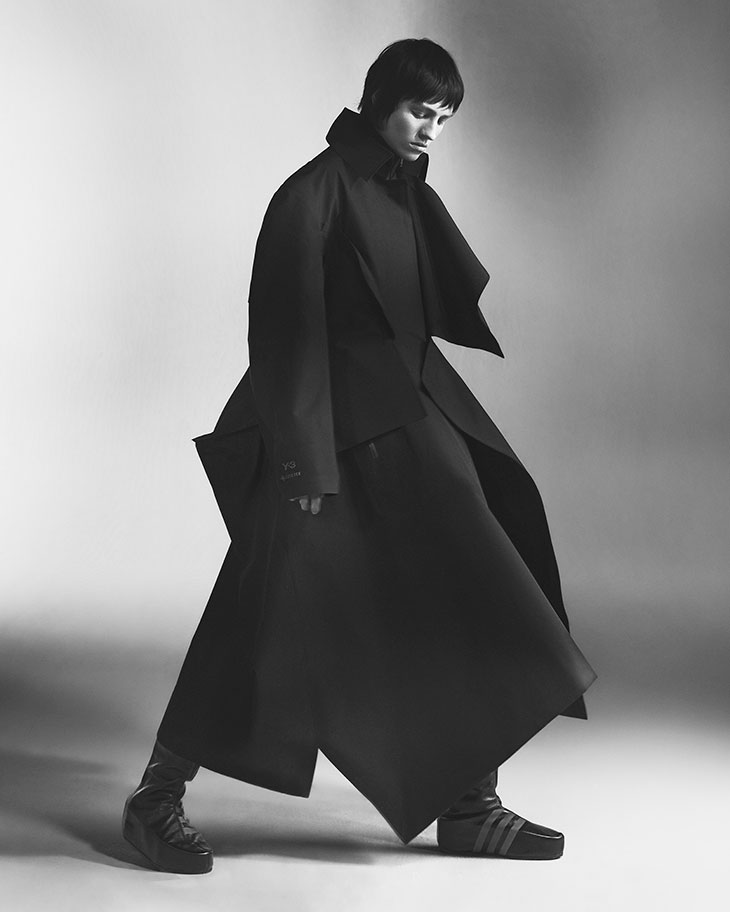
Y3 x Adidas, SS2024
“I think perfection is ugly,” Yamamoto declared in The Talks (2012). “..in the things humans make, I want to see scars, failure, disorder, distortion”. In a speech at Oxford, Yamamoto listed some of his favorite English words: contradiction, disobey, incomplete, enjoy, poignant, morphic, ludicrous. These words form a portal into the Shadow, the archetype of what we suppress. Shame, rage, longing…the parts we’re told not to show.
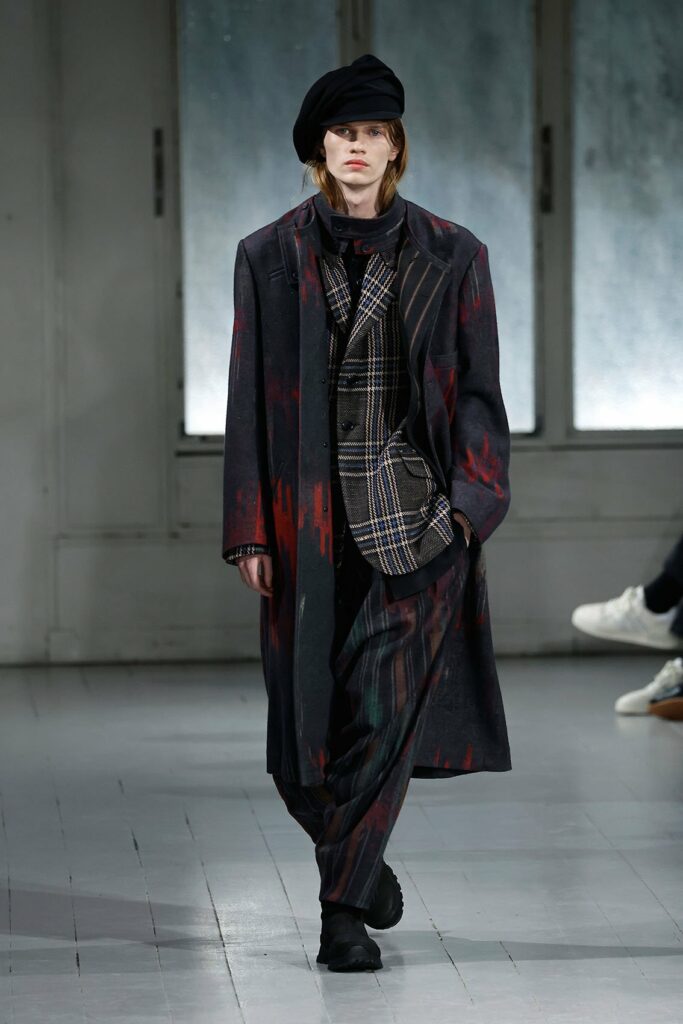
Yohji Yamamoto, AW2023
His blend of archetypes and his ode to anti-perfection remind us of a truth: commercial, polished ego-driven charades might lead us nowhere. Perhaps it’s time to embrace the ambiguity we hide from, which could guide us towards a wholeness beyond facade.
Persona, Shadow, and the Fashion Self
Jung theorized that we each wear a Persona—a mask shaped for social life. It protects the ego but can become a prison if mistaken for the true self. Fashion, with its performative nature, makes this especially visible. The avant-garde, however, pushes further – offering to unveil us.
Persona talks back-and-forth with the Shadow: the repressed, the chaotic, the rejected. In doing so, it becomes a form of individuation – Jung’s term for integrating the many sides of the self, including the dark, illogical, and nonconforming parts.
Dressing Movement, Memory and Myth
It’s not just what’s worn, but how. Archetypes also reveal themselves through movement and ritual. A coat swaying like a monk’s robe. A runway mimicking a funeral or reminiscing the schoolyard. These are symbolic stages echoing human experience.
Fashion goes beyond depicting archetypes by also invoking them. There is space for transformation, ambiguity, and expression beyond rational language.
Jung reminds us that we are carrying the history of humanity within us. He gives a kind of direction when he writes- “…your vision will become clear only when you look into your heart. Who looks outside, dreams; who looks inside, awakes.” (Jung, 2015). Avant-garde fashion invites us to do both, reminding us that we are not only dressing our bodies, but dressing memories, stories and myths.
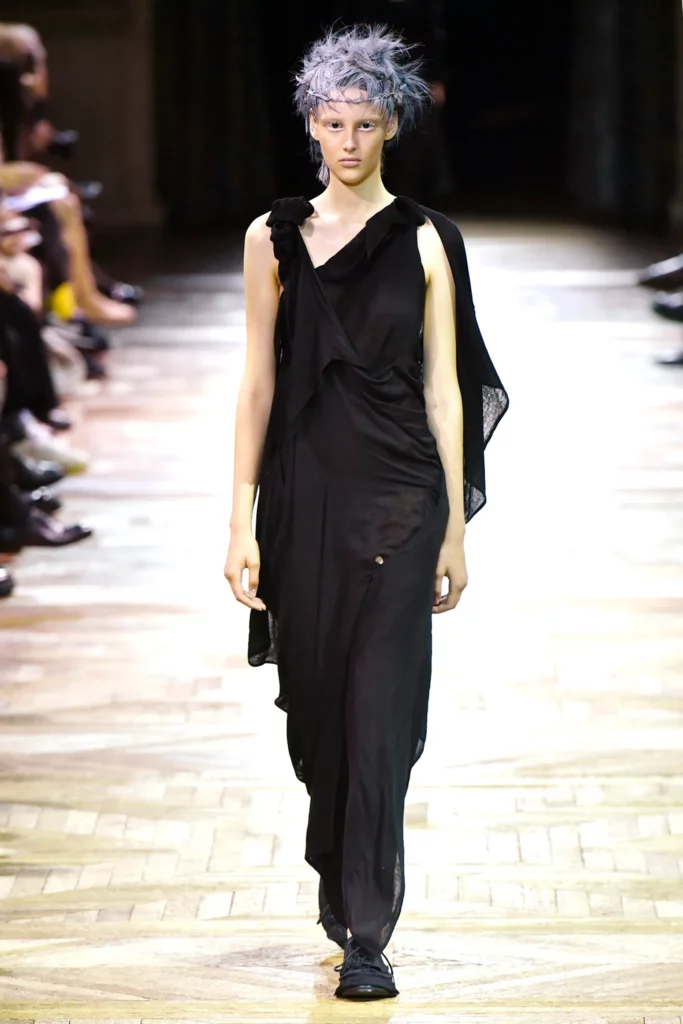
Yohji Yamamoto, SS2022
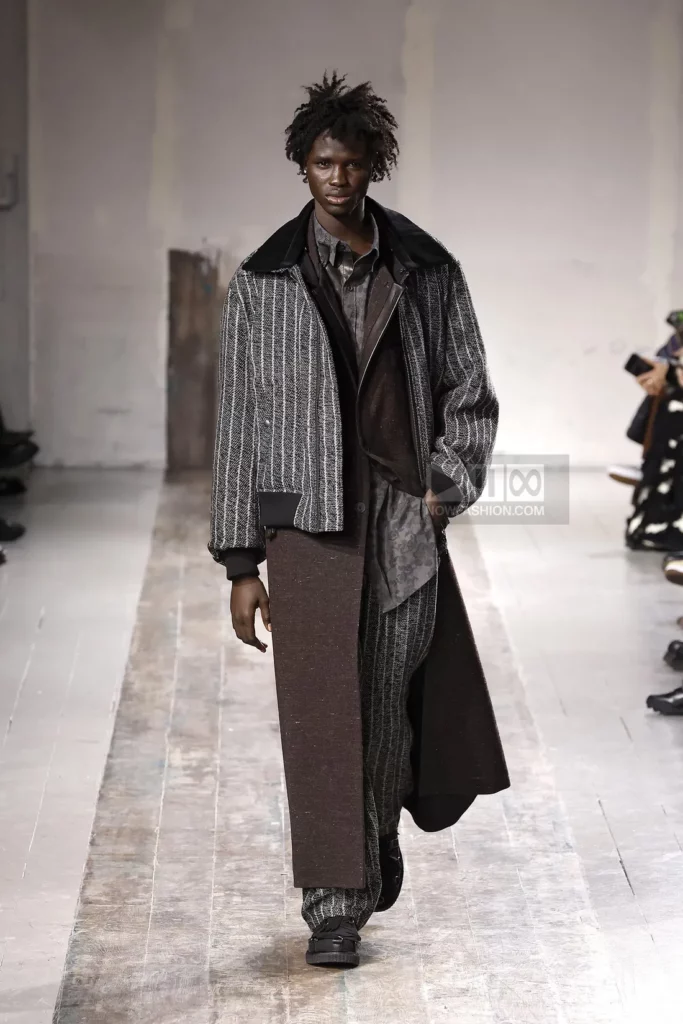
Yohji Yamamoto, FW2024
Credits
Written by Zaïna Pakabomba, @zigggyp