Desert Couture: The Fashion Evolution of Dune on Screen
How directors like David Lynch, Alejandro Jodorowsky, and Denis Villeneuve envisioned Dune’s universe, and how it continues to inspire avant-garde fashion.
On July 9, Dune: Part Three officially began filming, with Timothée Chalamet, Zendaya, and Jason Momoa reprising their roles. Unlike the previous two films, this chapter adapts Dune Messiah, the second book in Frank Herbert’s series, rather than continuing the first.
Published in 1965, Dune was long deemed unfilmable due to its scale and philosophical complexity. Still, it spawned a cult following, five sequels by Herbert, a dozen spin-offs by his son Brian and co-author Kevin J. Anderson, and numerous board and video games.
As its mythos expanded, so did its visual influence, both on screen and in fashion. Across decades and directors, Dune has shaped not only cinematic sci-fi but also the visual grammar of fashion, especially at the edge of apocalypse.
THE DUNE THAT NEVER WAS: JODOROWSKY’S DESERT DREAM
In the 1970s, Alejandro Jodorowsky envisioned a surrealist adaptation featuring Salvador Dalí, Orson Welles, Amanda Lear, and Mick Jagger, with music by Pink Floyd. Moebius and H.R. Giger designed the concept art. Despite diverging significantly from the source material, Jodorowsky’s script would have produced a 14-hour epic. By the time $2 million of a $9.5 million budget had been spent in pre-production, the project was inevitably shelved.
Yet its legacy endured. Moebius’s designs, with their medieval-meets-futurist aesthetic, heavily influenced his and Jodorowsky’s later comic The Incal. Giger’s terrifying designs for the House of Harkonnen- organic, skeletal, and erotic- were later repurposed for Alien, winning him an Oscar and setting the tone for decades of sci-fi horror. His visual language remains deeply influential in fashion, especially in fetishwear and biomechanical design.
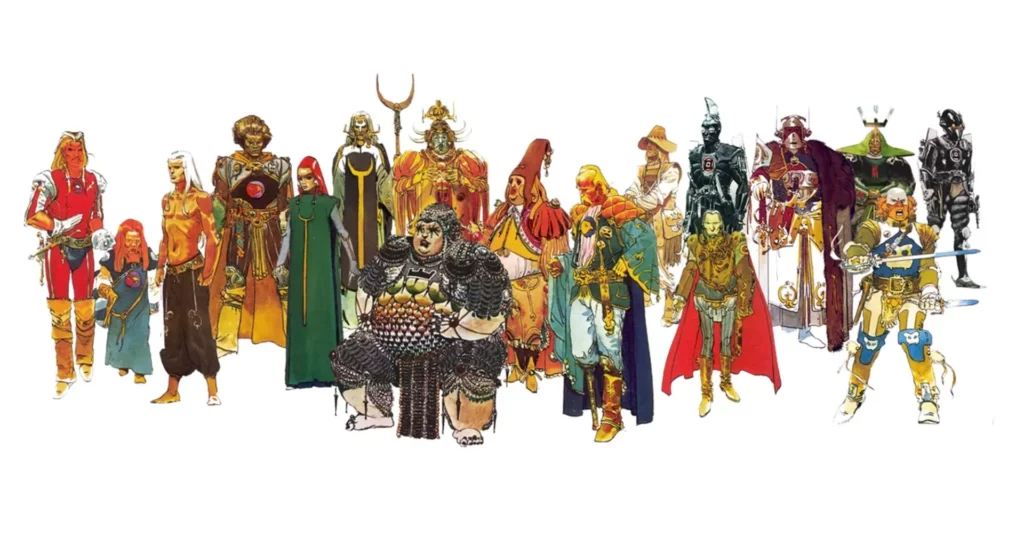
Dune Concept art by Moebius, 1970’s
FROM GIGER TO STING’S JOCKSTRAP: LYNCH’S SCI-FI EXCESS
After Jodorowsky’s attempt collapsed, Dune remained in development hell. Then Star Wars changed everything. Eager to capitalize on the genre’s popularity, producer Dino De Laurentiis, who held the rights, pursued his own sci-fi epic. After a failed collaboration with Ridley Scott, he turned to a young David Lynch.
Lynch, who had rejected Return of the Jedi and wasn’t a fan of science fiction, accepted. The film was shot in Mexico and heavily condensed to fit a two-hour runtime. Lynch had minimal control in post-production and later disowned the film entirely.
Still, it yielded striking visuals, somewhat kitsch, undeniably 80s, and not what one might expect from Lynch. The stillsuits, worn by the desert dwellers on Arrakis to preserve moisture, are perhaps the clearest echo of Giger’s legacy: black rubber, padded musculature, and winding tubing. Tribal yet futuristic, they arguably influenced later superhero costume design.
Costume designer Bob Ringwood revealed many costumes were crafted from repurposed items, harnesses, car hoses, even used body bags. The Guild navigators’ jet black, puffy, cyberpunk gear featured rubber tubing and built-in gloves. Baron Harkonnen’s monstrous harness, strapped to his bare chest, was so heavy that actor Kenneth McMillan had to be wheeled around between takes. He often concealed it with a long black-and-red coat.
The women’s costumes stood out for their theatrical flair. Lady Jessica’s retro-futuristic white dress was striking. Princess Irulan’s wardrobe, Victorian with Art Deco and Weimar accents, embodied the film’s hybrid aesthetic. Atreides uniforms recalled Tsarist Russia, while the Reverend Mothers’ black veils evoked Middle Eastern influence. Over 2,000 Asian-inspired wicker headdresses were made but never used.
And then there was Sting’s infamous winged jockstrap, a last-minute choice after producers nixed full nudity. Campy then, iconic now.
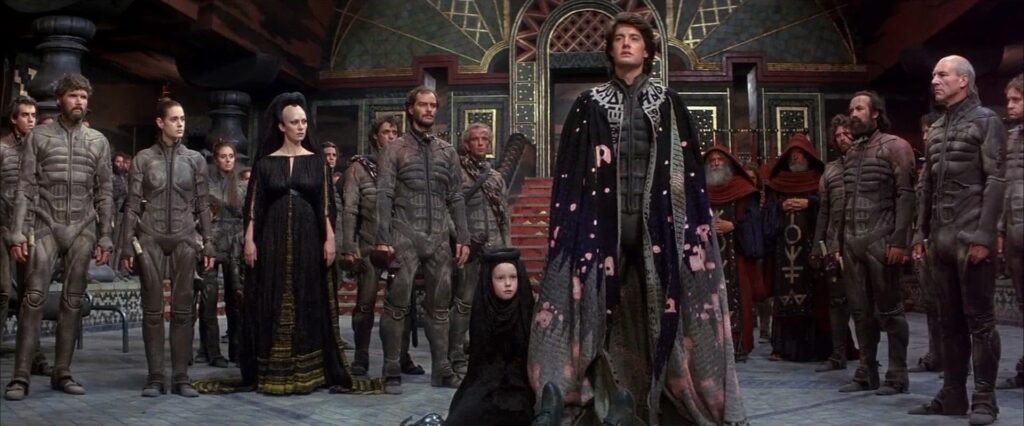
A still from David Lynch’s Dune (1984)
VILLENEUVE’S DESERT MINIMALISM AND ITS FASHION ECHOES
Denis Villeneuve’s adaptation promised a dramatic departure, both narratively and visually. His vision combined minimalist brutalism, earthy palettes, and Arab futurism. Jacqueline West and Bob Morgan handled costume design for the first film; West returned solo for Part Two.
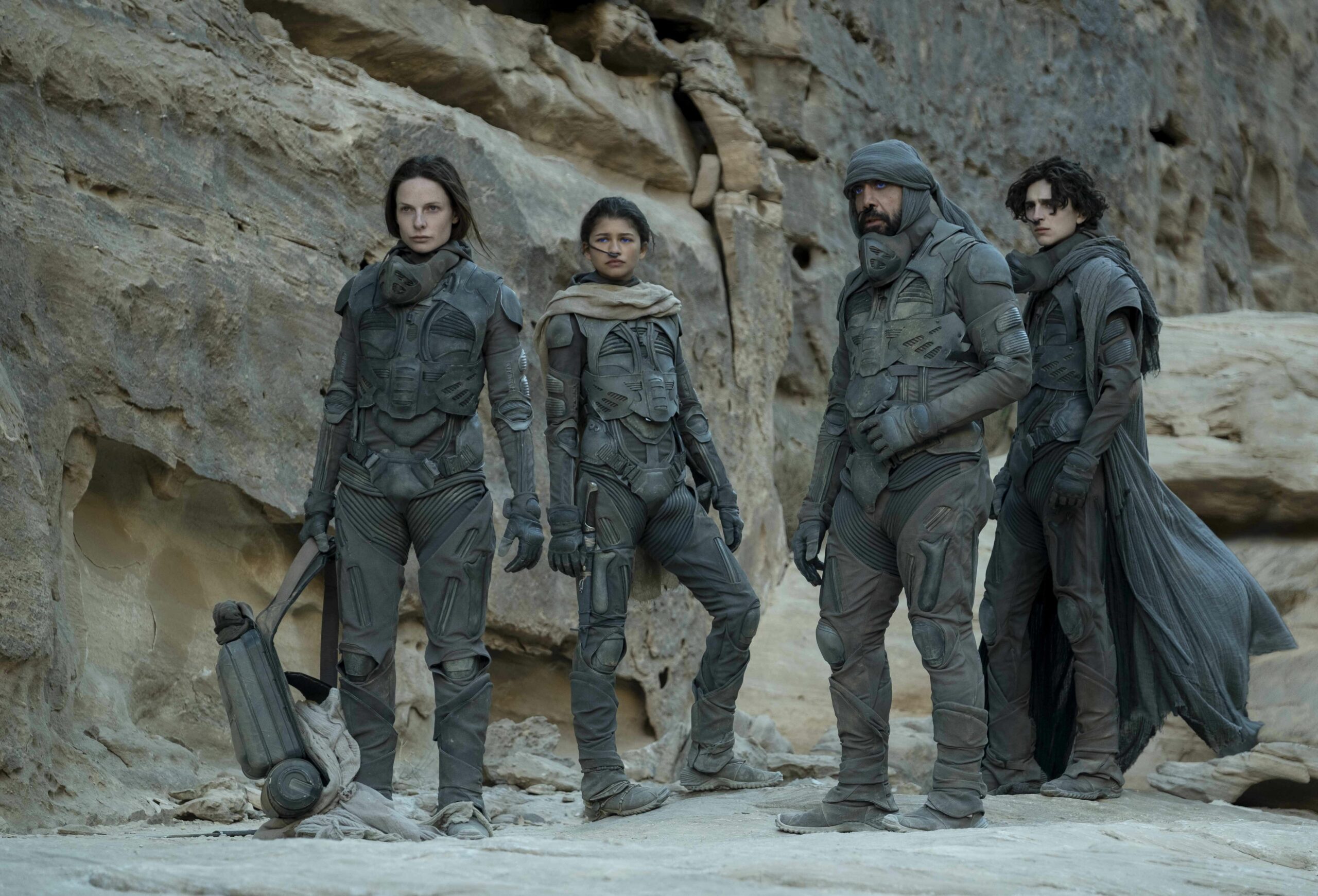
The stillsuits became functional, believable survival gear. The Fremen, inspired by WWII resistance fighters and Tuareg nomads, felt grounded yet mythic. In contrast, the Sardaukar, brutal enforcers, drew from fascist imagery.
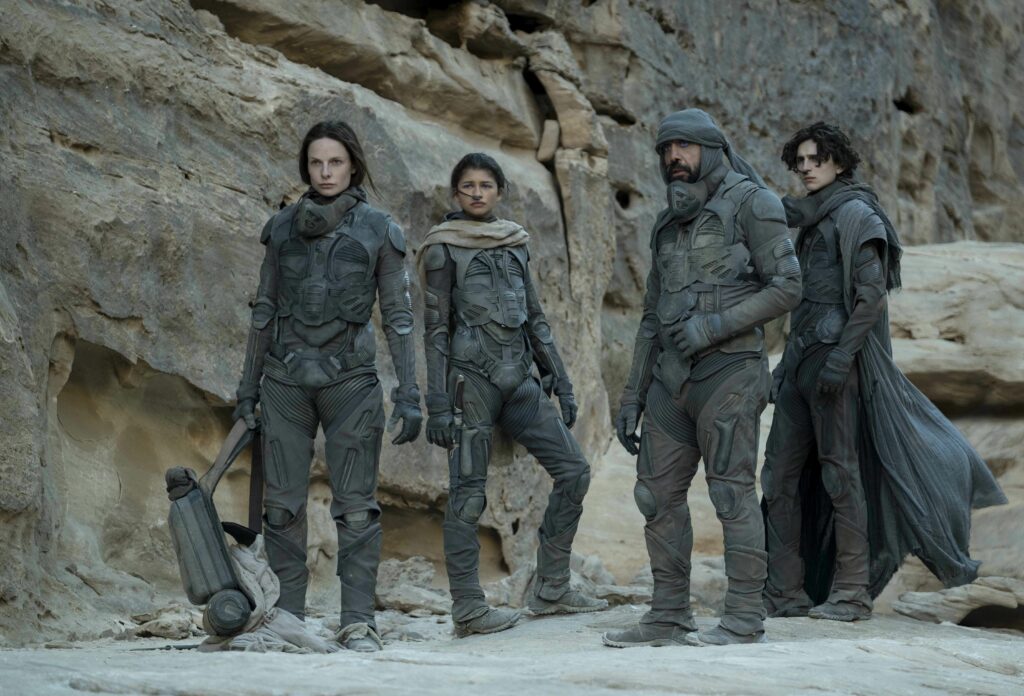
Villeneuve’s Dune characters in Fremen attire, 2021
Feyd-Rautha (Austin Butler) traded Sting’s jockstrap for a Giger-esque black leather ensemble. “We wanted him to evoke a kind of Gothic vampire early, early dark medieval feeling,” said West, “but yet be the future.” In one scene, he is surrounded by ghostlike bullfighters in wide-brimmed hats inspired by Goya and Cocteau’s drawings. Filmed in infrared, the scene required careful black fabric selection to avoid turning white on camera.
The Harkonnens now fully embrace BDSM aesthetics. One corset, referencing the circles of hell in Dante’s Inferno, was made of leather strips and tiny black bones. The Baron dons an exaggerated, wormlike black robe that amplifies his menace as he hovers. His fingers drip with rings, one concealing a personal shield generator.
Lady Jessica’s dresses in the first film were inspired by classic designs of Cristóbal Balenciaga, and so is the black and blue taffeta dress worn by Léa Seydoux’s Lady Fenring in Part Two. However, as Lady Jessica’s role shifts, she turns to gauzy veils and Tuareg-inspired robes. West sourced vintage Tiffany jewelry and North African pieces, deconstructing and reassembling them to create something ancient yet futuristic.
Princess Irulan debuts in Part Two clad in armor-like headpieces and chainmail gowns, channeling Joan of Arc and Tarot archetypes, especially the Queen of Swords. The Bene Gesserit’s aesthetic, steeped in mysticism, also draws from Giotto’s Madonnas.
FROM RED CARPETS TO RUNWAYS: ZENDAYA, RICK OWENS AND BEYOND
Dune’s fashion impact didn’t stop at the screen. Zendaya and Florence Pugh embraced full Arrakis glamour during the Dune: Part Two press tour.
In Mexico, Zendaya wore a twisted two-piece by British-Nigerian-Brazilian designer Torishéju Dumi; later, she stunned in a brown skirt and turtleneck top by Bottega Veneta, while Pugh wore a sheer white Galvan gown. In Paris, Zendaya appeared in a sculptural white Maison Alaïa piece, followed by a custom textured gold Louis Vuitton. In London, she channeled a robot in a vintage metallic Thierry Mugler piece. Pugh sported a brown sequin, long-trained, hooded dress. In New York, she floated in a grey pleated halter Valentino, while Zendaya wore a Stéphane Rolland white long-sleeve dress with cut-outs and gold embellishments at the hem. In Seoul, Zendaya and Chalamet twinned in Juun.J jumpsuits.
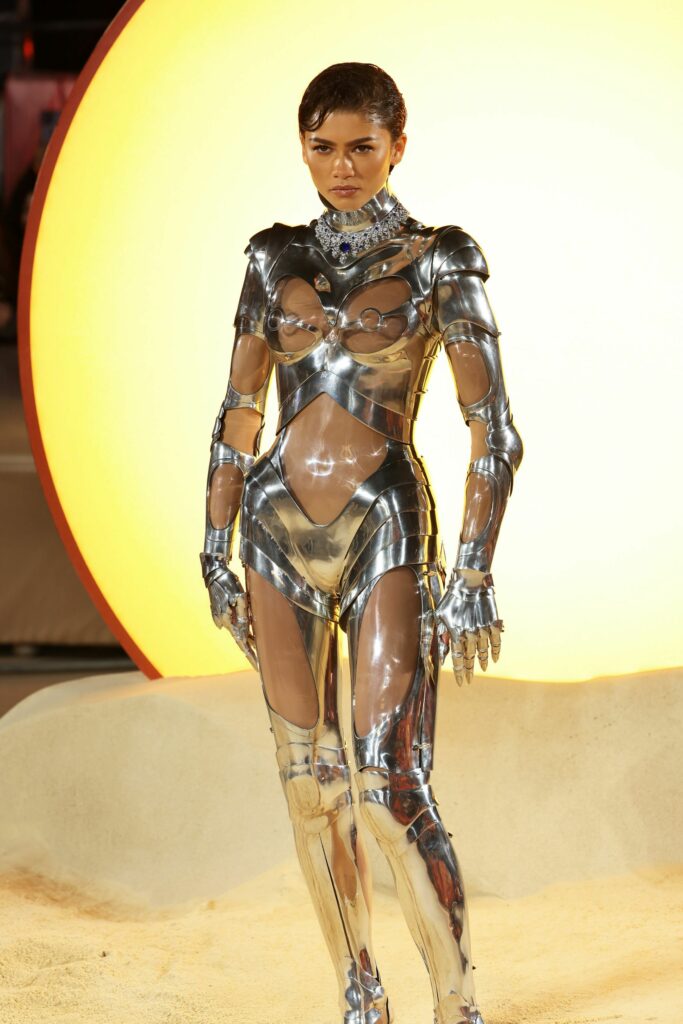
Zendaya in Mugler at the World Premiere of Dune: Part Two (2024)
Balenciaga’s 2013 Dune Lambskin Mini Bag predated the film revival. Under Demna, the AW20 line leaned into jackets and combat boots in black and navy blue, with chest, shoulder, and knee pads. Louis Vuitton’s AW20 by Nicolas Ghesquière blended mysticism and utility, linens, geometric cuts, tailored jackets, loose shirts, and dresses in black, earth, red, and midnight blues. Rick Owens’ AW24 could easily clothe Villeneuve’s cast: sharp lines, layered leather, and monastic silhouettes.
Dilara Findikoglu, Coperni, and Off-White’s AW23 show continued this desert dystopia. At the 2021 Met Gala, Grimes wore an Iris van Herpen gown dubbed “The Bene Gesserit”, 26 meters of silk, blade-like and alien. And during her bizarre L.A. outing reading the Communist Manifesto after her split with Elon Musk, she was spotted in post-breakup attire, a cloak from Demobaza, a Bulgarian label calling its work “reconstructed uniform.” She claimed it was inspired by Lady Jessica.
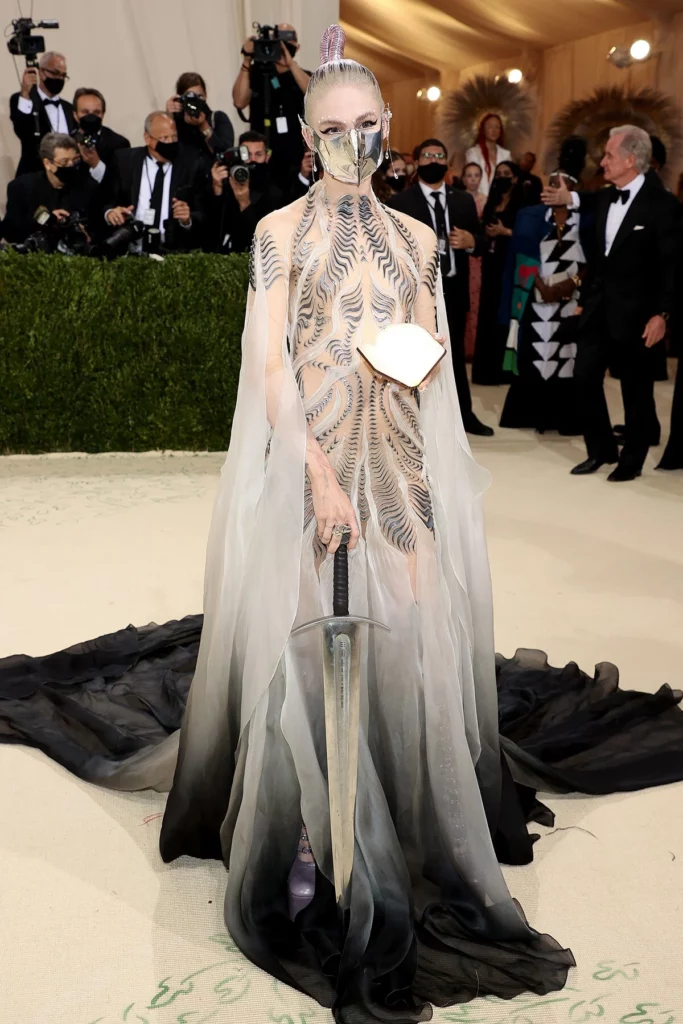
Grimes wearing Iris van Herpen at the 2021 Met Gala
THE FUTURE IS DESERT: DUNE AND THE FASHION OF APOCALYPSE
Why does Dune continue to shape our vision of the future? Perhaps because real life consistently falls short of sci-fi’s glittering promises. Los Angeles in 2019 didn’t look like Blade Runner, and by 2049, it still won’t.
Dune fuses past and futuristic codes, military garb, religious iconography, architectural minimalism, to suggest a world simultaneously ancient and advanced. This layered vision resonates with designers navigating a post-pandemic world marred by anxiety, crisis, and reinvention. In fashion, as in fiction, the apocalypse isn’t just survived, it is styled.
So if collapse is near, we might as well face it swathed in velvet capes, draped in gauze, and shielded by sleek leather armor.
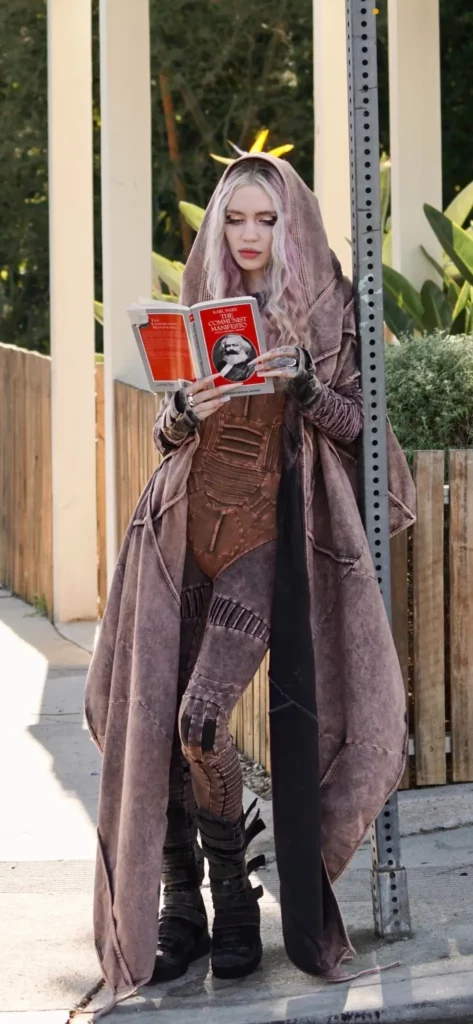
Grimes reading the Communist Manifesto in Demobaza 2022
Credits
Written by Nacho Pajin @nachopajin